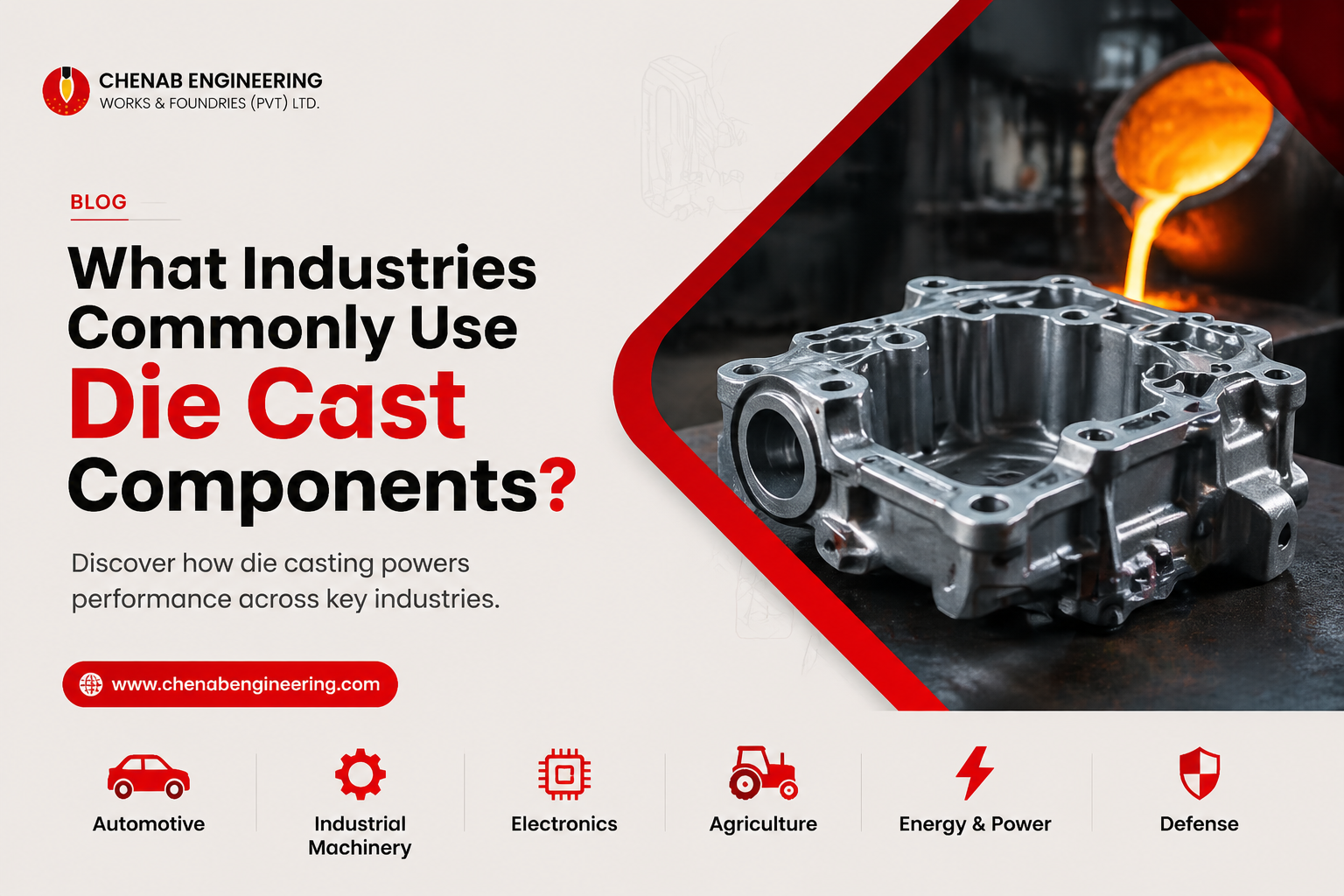
Die cast components are among the most widely used parts in modern industrial manufacturing. Produced by forcing molten metal into precision-engineered moulds under high pressure, die casting delivers parts that are strong, dimensionally accurate, and cost-effective at scale. From the engine compartment of a family car to the housing of a medical diagnostic device, die-cast parts are embedded in the infrastructure of virtually every major industry.
This guide covers the full landscape of die casting industries, the materials commonly specified, and what to look for when selecting a manufacturer.
Why Are Die-Cast Components Used Across So Many Industries?
The widespread adoption of die casting is driven by a combination of technical and commercial advantages. Compared to other metal-forming processes, such as sand casting or machining from billet, die casting offers:
- Dimensional accuracy: Tight tolerances are achievable consistently across high-volume runs, reducing the need for secondary machining.
- Strength and durability: Die-cast metal components offer excellent structural integrity, often outperforming plastic alternatives without added weight.
- Lightweight design: Aluminum and magnesium alloys produce lightweight components ideal for transport and aerospace sectors.
- Cost-efficiency at scale: Once tooling is established, per-unit costs fall significantly, making die casting highly economical for mass production.
- Complex geometries: Die casting allows for intricate shapes, thin walls, and integrated features, all produced in a single production step.
- Surface finish quality: Parts emerge with smooth finishes suitable for direct use or minimal post-processing.
These qualities make die cast parts manufacturing a reliable solution for sectors where reliability, precision, and repeatability are non-negotiable.
Industries That Commonly Use Die Cast Components
Automotive Industry
The automotive sector is the largest consumer of die-cast components globally. Vehicle manufacturers and their supply chains depend on precision die casting to produce parts that must withstand mechanical stress, thermal cycling, and constant vibration, all while minimizing weight.
Common automotive die cast parts include:
- Engine blocks and cylinder heads
- Transmission housings
- Gearbox casings
- Suspension brackets and mounts
- Steering column components
- Fuel system housings
Aluminum die cast components are particularly prevalent in automotive applications, offering the strength of metal at a fraction of the weight, directly contributing to fuel efficiency and reduced emissions. The shift to electric vehicles has further increased demand, as battery housings, motor casings, and structural chassis parts are frequently produced through die casting.
Aerospace Industry
Aerospace die cast components must meet some of the most demanding engineering standards in existence. Parts must perform reliably across extreme temperature ranges, resist corrosion, and maintain structural integrity under considerable mechanical load, all with minimal weight.
Typical aerospace applications include:
- Avionics housings and enclosures
- Hydraulic system components
- Structural brackets and mounts
- Actuator bodies
- Air management system parts
- Interior cabin hardware
Precision die casting is essential in this sector. Even minor dimensional deviations can have safety implications, underscoring the importance of die casting repeatability. Aluminum and magnesium die-cast components are most commonly specified due to their strength-to-weight ratios.
Defence and Military Industry
The defence sector requires components that perform under extreme operational conditions, ranging from desert heat to arctic cold, whilst maintaining dimensional accuracy and mechanical resilience. Die-cast components are used extensively in:
- Armoured vehicle structural parts
- Weapons system housings and brackets
- Communication and electronic equipment enclosures
- Field equipment and portable device casings
- Optics and targeting system mounts
Die casting supports defence procurement requirements by enabling consistent production of identical, interchangeable parts, a critical requirement for field maintenance and logistics.
Electronics and Electrical Industry
The electronics and electrical sector relies heavily on industrial die cast parts for thermal management, electromagnetic shielding, and component protection. The ability to produce thin-walled, complex enclosures in thermally conductive materials makes die casting indispensable.
Key applications include:
- Heat sinks for power electronics
- LED lighting housings and frames
- Motor and inverter enclosures
- Electrical connectors and terminals
- Switchgear housings
- Data center cooling components
Aluminum die cast components are especially valued here for their natural thermal conductivity and electromagnetic shielding properties, helping to dissipate heat and protect sensitive electronics from interference.
Industrial Machinery Industry
Industrial machinery components must endure continuous operation, often in harsh environments involving chemicals, pressure, and mechanical wear. Die casting delivers the tight tolerances and material integrity required for these demanding conditions.
Common parts produced include:
- Pump housings and impellers
- Valve bodies and manifolds
- Gearbox and drivetrain housings
- Compressor components
- Hydraulic cylinder end caps
- Machine frames and structural supports
The dimensional accuracy of precision die casting ensures that mating surfaces align correctly, seals seat properly, and assemblies function without play or misalignment. This is critical in machinery that operates under pressure or at speed.
Construction and Hardware Industry
The construction and hardware sector uses die-cast components in applications that combine aesthetic appeal with functional durability. Zinc die cast components are particularly popular here due to their excellent castability and ability to be plated or finished to a high standard.
Typical components include:
- Door handles and lever sets
- Mortice lock bodies and cylinders
- Hinges and pivot mechanisms
- Window fittings and stays
- Bathroom and kitchen fixtures
- Structural connectors and fasteners
Die casting allows hardware manufacturers to produce decorative and functional parts simultaneously, with consistent finish quality across large production runs.
Medical Equipment Industry
Medical device manufacturers require components that meet strict hygiene standards, maintain dimensional accuracy over time, and can withstand sterilization processes. Die casting meets these requirements while supporting the production of complex, multi-functional parts.
Applications include:
- Housings for diagnostic imaging equipment
- Surgical instrument frames and handles
- Dental equipment components
- IV stand and hospital bed fittings
- Laboratory device enclosures
- Rehabilitation equipment structural parts
Aluminum is a common choice in medical die casting due to its corrosion resistance and compatibility with surface treatments that meet clinical hygiene requirements.
Consumer Goods Industry
Consumer product manufacturers turn to die casting when they need parts that are both aesthetically pleasing and mechanically robust. Metal die-cast components give consumer goods a premium feel and longer service life than comparable plastic alternatives.
Common applications include:
- Power tool housings and gearboxes
- Kitchen appliance components
- Domestic heating system parts
- Garden power equipment casings
- Audio equipment enclosures
- Sports and leisure equipment fittings
The ability to produce consistent, high-volume components at low per-unit cost makes die casting particularly attractive for consumer goods manufacturers operating in competitive, price-sensitive markets.
Telecommunications Industry
Telecommunications infrastructure must be weather-resistant, electromagnetically shielded, and structurally sound, all requirements that die casting addresses effectively. As 5G networks expand globally, demand for precision-cast enclosures and mounting hardware continues to grow.
Die-cast parts used in telecoms include:
- Antenna housings and mounts
- Radio frequency (RF) filter enclosures
- Base station equipment casings
- Connector bodies and shells
- Cable management components
- Outdoor junction boxes
Aluminum is the material of choice for most telecom die casting applications, providing natural electromagnetic shielding whilst maintaining low weight for mast and pole-mounted equipment.
Renewable Energy Industry
As renewable energy generation scales globally, the demand for reliable, cost-effective components is increasing rapidly. According to the International Energy Agency (IEA), renewable capacity is projected to expand significantly through the coming decade, driving sustained demand for precision-cast parts. Die casting plays a key role in producing components for solar, wind, and other clean energy systems.
Applications include:
- Solar panel mounting brackets and frames
- Inverter and charge controller housings
- Wind turbine nacelle components
- Heat exchanger parts for energy systems
- Battery storage system enclosures
- Grid connection equipment housings
The durability and corrosion resistance of aluminum die-cast components make them well-suited to outdoor installations, where parts must withstand decades of exposure to the elements.
Which Materials Are Commonly Used for Die-Cast Components?
The choice of material significantly influences the performance, weight, and cost of a die-cast component. The most commonly used alloys in die-cast parts manufacturing are:
- Aluminum (most widely used): Lightweight, corrosion-resistant, and thermally conductive. Aluminum die-cast components are found across automotive, aerospace, electronics, and telecoms applications. Typical alloys include A380 and ADC12.
- Zinc: Zinc die-cast components offer excellent dimensional accuracy, a smooth surface finish, and are ideal for smaller, intricate parts. Common in hardware, electronics, and consumer goods. Zamak alloys (Zamak 3, Zamak 5) are most frequently used.
- Magnesium: The lightest structural metal commonly die cast. Magnesium is used where weight reduction is critical, particularly in automotive interiors, handheld devices, and aerospace applications.
- Copper alloys (brass/bronze): Offer superior strength and wear resistance. Used in plumbing, marine hardware, and specialist engineering applications. Less common due to higher cost.
- Lead and tin alloys: Used in niche applications requiring low melting points or radiation shielding. Largely restricted due to health and environmental regulations.
Material selection should be driven by the mechanical, thermal, and environmental requirements of the application, alongside cost and production volume considerations.
How to Choose the Right Die Cast Component Manufacturer
Selecting the right manufacturing partner is as important as the design of the component itself. When evaluating suppliers, consider the following criteria:
- Material expertise: Confirm the manufacturer has proven experience with your required alloy. Not all die casters work with every material, and alloy-specific knowledge affects tooling design, process parameters, and part quality.
- Precision and tolerances: Request information on the dimensional tolerances routinely achieved. For precision die casting applications, ask for process capability data (Cpk values) rather than general claims.
- Quality management: Look for ISO 9001 certification as a baseline. Industry-specific certifications such as IATF 16949 (automotive) or AS9100 (aerospace) indicate capability within regulated sectors.
- Tooling design and ownership: Clarify who owns the tooling and what guarantees exist around tool life and maintenance. Tooling quality directly affects part consistency over long production runs.
- Secondary processing capabilities: A manufacturer offering machining, surface treatment, assembly, and inspection in-house reduces lead times and supply chain complexity.
- Production capacity and scalability: Ensure the supplier can meet your current volume requirements and has the capacity to scale as demand grows.
- Design for Manufacture (DfM) support: The best suppliers offer DfM reviews to identify potential issues early, saving time and cost before tooling is committed.
Conclusion
Die-cast components are essential across virtually every major manufacturing sector, delivering high-quality, durable parts cost-effectively and at scale. Their applications span from the powertrain components of electric vehicles to the enclosures of 5G base stations and the structural frames of solar installations.
For procurement teams and engineers seeking reliable, precision-engineered metal parts, understanding the breadth of die casting applications is the first step towards smarter sourcing decisions. The right die-cast component, produced by the right manufacturer, delivers long-term value well beyond the initial unit price. To discuss your requirements with Chenab Engineering Works, get in touch.
Frequently Asked Questions
1. What is die casting and how does it work?
Die casting is a metal-forming process in which molten metal, typically aluminium, zinc, or magnesium, is injected into a hardened steel mould (the die) under high pressure. The metal solidifies rapidly within the die, which is then opened to eject the finished part. The process is fast, repeatable, and capable of producing complex, near-net-shape components with excellent surface finish and tight dimensional tolerances. It is most economical at medium to high production volumes, where the cost of tooling is spread across a large number of parts. The NADCA provides a detailed technical overview of the process.
2. Why are die-cast components popular in the automotive industry?
Automotive manufacturers value die casting for its ability to produce lightweight, high-strength parts at high volumes and low per-unit costs. Aluminium die cast components such as engine blocks, transmission housings, and structural brackets help reduce vehicle weight, which directly improves fuel efficiency and reduces emissions. The dimensional accuracy of die casting also ensures consistent fitment across millions of vehicles.
3. What materials are typically used in die casting?
The most commonly used materials in die casting are aluminium, zinc, and magnesium alloys. Aluminium is the most widely specified due to its lightweight nature, corrosion resistance, and thermal conductivity. Zinc alloys (Zamak) are used for smaller, highly detailed parts requiring excellent surface finish. Magnesium is chosen where maximum weight reduction is required. Copper alloys are used in specialist, high-wear applications but are less common due to higher material and processing costs.
4. How do die-cast components benefit the aerospace industry?
In aerospace, die casting provides the precision and material consistency required for safety-critical components. The process allows complex geometries to be produced with repeatable accuracy, eliminating the variability that can arise from manual fabrication methods. Lightweight aluminium and magnesium die cast components help reduce aircraft weight, directly impacting fuel consumption and payload capacity. Integrating multiple features into a single die-cast part also reduces assembly complexity and the number of potential failure points in a system.
5. What should I look for in a die-cast component manufacturer?
Prioritise material expertise, demonstrated precision supported by process capability data, and relevant quality certifications such as ISO 9001, IATF 16949, or AS9100. Assess whether the supplier offers in-house tooling, secondary processing, and DfM support. A strong manufacturer will act as a technical partner, helping to optimize part design and reduce the total cost of ownership across the product lifecycle