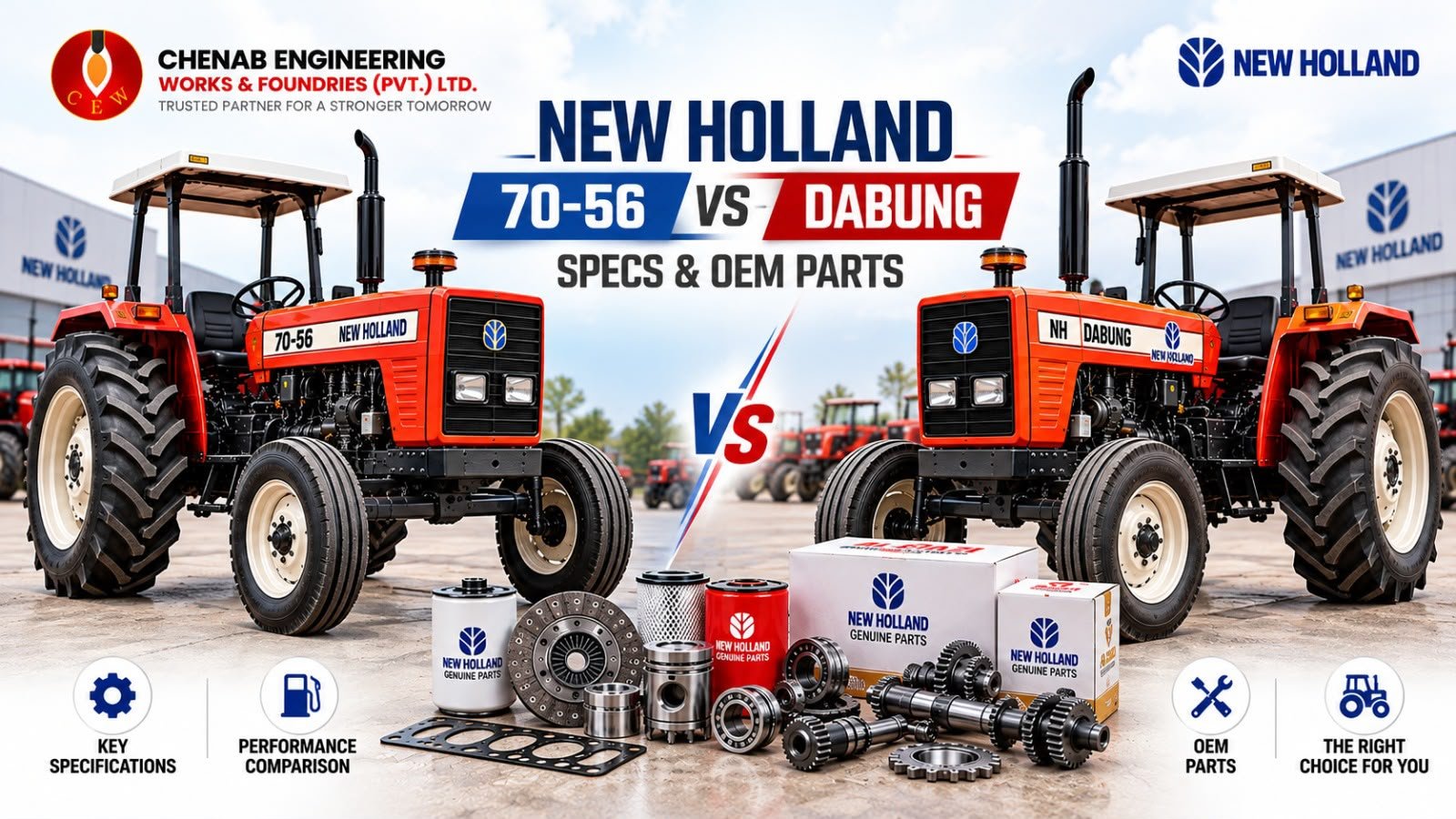
Farmers comparing the New Holland vs. the Dabung need clear facts before buying. Both machines deliver eighty-five horsepower but handle very different field conditions daily. The New Holland brings 4-wheel drive traction, while the Dabung uses 2-wheel drive simplicity.
Understanding the New Holland 70-56 vs Dabung differences saves you from costly mistakes. We will break down specs, prices, and parts in plain language for farmers. The New Holland vs Dabung decision depends on your soil type and tasks. You need honest information to choose the right tractor for your specific needs.
Engine Specs and Drive System Comparison
- Both models use a 4-cylinder diesel engine with approximately 4.0L displacement.
- The Dabung features 4WD for superior traction in wet and muddy fields.
- The Dabung uses a 2WD configuration designed for standard row-crop applications.
- Power Output and Engine Design
Both tractors produce 85 HP at the flywheel by means of proven technologies. The diesel engine is equipped with direct fuel injection that enables good fuel economy so that you do not have to spend too much money on fuel. The four-cylinder engine provides good torque at all RPMs.
Farmers reported that they were able to operate the tractor pulling heavy equipment through challenging soils on a regular basis.
- Drive Configuration Differences
The New Holland comes built as a heavy-duty 4WD machine for maximum traction. This system provides superior drawbar pull and control in wet, slippery, or steep fields. The New Holland Dabung is built as an 85 HP 2WD tractor for general farm work. It was designed to directly rival the Massey Ferguson 385 2WD in standard applications.
Terrain Suitability and Task Performance
- The Dabung handles heavy cultivation, deep plowing, and front-end loader attachments easily.
- The Dabung excels at general-purpose plowing, tilling, seeding, and harvesting operations.
- Four-wheel grip is mandatory for challenging soil or gradient conditions on slopes.
- Heavy-Duty Applications
This is best suited for heavy cultivation and deep plowing in tough terrain. Front-end loader attachments work perfectly with the 4-wheel drive system for stability. Challenging soil or gradient conditions require the mandatory four-wheel grip this model provides. The robust build handles demanding agricultural applications without straining the engine components excessively.
- General Farm Operations
The Dabung has been designed for general plowing, tilling, and seedbed preparation on larger jobs. The 2WD feature allows for easier and faster maneuvering and reduces overall complexity of operation. Most standard row-crop work fits within this tractor's capabilities, and the farmers want simpler maintenance procedures than are required with more complicated four-wheel drive systems.
Pricing Breakdown and Market Status
- The New Holland costs Rs. 4,575,000 for brand-new units today.
- The Dabung was priced at Rs. 3,430,000 before being discontinued recently.
- Well-maintained used Dabung units are available at various prices based on condition.
Source: Al-Ghazi
- Current Market Prices
Model Horsepower Drive Type Lifting Capacity Price (Rs.) Status New Holland85 HP4WD2,200 kg4,575,000Active New Holland Dabung85 HP2WD2,150 kg3,430,000Discontinued NH 850 Economy85 HP2WD2,150 kg3,815,000Active NH 850 Lift-O-Matic85 HP2WD2,200 kg4,150,000Active- Why Prices Differ
The 70-56 costs more due to the complex four-wheel drive system and components. This extra investment pays off through better traction and fuel efficiency in tough conditions. The Dabung offered excellent value with its simpler two-wheel drive design and lower price. Although discontinued, used units still provide great value for farmers on tighter budgets.
- Availability and Alternatives
Al-Ghazi Tractors discontinued the Dabung to focus on newer models like the NH 850 series. The 70-56 remains in active production and competes with the Massey Ferguson 385 4WD. Parts availability stays good since both models share components with other New Holland tractors. Farmers looking for alternatives should consider the NH 850 series with updated features.
Operator Comfort and Maintenance Access
- Both tractors feature hydrostatic power steering for easier operator control and maneuverability.
- The 70-56 has a classic rugged build with a flat-top square fender design.
- Oil-immersed disc brakes provide dependable stopping power during demanding field operations.
- Comfort Features
Both models feature hydrostatic power steering for smoother and easier operator control daily. The 70-56 includes a spring-suspension deluxe seat for maximum comfort during long shifts. The classic rugged build with flat-top square fender provides safe standing platforms. Operators appreciate the 3-point link hydraulic lifter plus ergonomic workstation layout design.
- Maintenance Considerations
The simpler 2WD design of the Dabung means easier maintenance access and lower costs. Oil-immersed disc brakes on both models ensure dependable stopping power under heavy loads. The 70-56 requires more regular attention to front axle and transfer case maintenance. Both tractors use common filters and wear items available at local workshops nationwide.
Replacement Parts and Component Availability
- Genuine parts ensure optimal performance and extend the tractor operational life significantly.
- Both models share many components with other New Holland tractors for easy sourcing.
- Local manufacturers produce high-quality castings meeting original equipment specifications perfectly.
Heavy-Duty Cast Components
- Axle Housing 385 RH:
This heavy casting forms the right side of the rear axle assembly. It protects the internal differential gears from mud, dust, and constant field impacts. We cast it with extra-thick walls to resist cracking under extreme pulling loads. Precision machining ensures perfect alignment with your axle shafts and brake components.
- Hub 385:
The wheel hub connects the wheel to the axle and handles constant rotation. It must handle heavy rotation while carrying the full weight during field operations. We manufacture these using premium high-grade cast iron for maximum durability. Precise CNC machining guarantees a smooth bearing fitment and perfectly balanced wheel rotation.
- Front Support 350:
This casting connects the engine to the front axle on similar tractor models. It takes on all steering forces while supporting the heavy front-end weight daily. We machine every single support to exact OEM specifications for a perfect fit. Our foundry uses high-grade iron that stands up to the daily beating of rough farming.
- Cap Lift Cover:
This cover seals the top of the hydraulic system and controls the lift arms. It maintains the high oil pressure needed to raise heavy plows and trailers safely. We machine the internal ports carefully to prevent leaks and ensure smooth operation. Proper heat treatment stops the metal from warping when hydraulic oil gets hot.
- Front Support MF 240:
This solid casting bolts the engine block directly to the front axle securely. It absorbs all the steering stress and carries heavy front-end weight during daily work. We pour it from high-grade iron and machine the bolt holes perfectly always. A tough heat treatment keeps the metal from cracking under heavy loads.
- Pivot Diff Lock:
This tough component engages the differential lock when you need extra grip in mud. It allows both rear wheels to lock together so you can pull yourself out. We cast it from high-strength iron to resist bending when the drivetrain is strained. Precision machining keeps the moving parts smooth so the lock engages easily every time.
Farmers often research parts availability before purchasing older tractor models for their farms. Understanding component costs helps you budget for maintenance throughout the entire year effectively. For instance, browsing the tractor parts catalog shows what replacement components cost locally.
This practical knowledge ensures you can maintain your tractor affordably for many years. Proper planning prevents unexpected financial burdens when repairs become necessary during busy seasons. Farmers looking for detailed specs should check the Al-Ghazi NH Dabung Tractor page.
Service Intervals and Common Wear Items
- Regular oil changes every 250 hours prevent internal engine wear and damage.
- Air filters require cleaning or replacement every 50 hours in dusty field conditions.
- Both tractors need regular hydraulic fluid level checks before starting major operations.
- Routine Maintenance Schedule
Engine oil changes prevent internal component wear and extend the engine's operational life significantly. Air filters must be cleaned regularly to protect the engine from abrasive dust particles. Hydraulic fluid levels need checking before each major field operation for safety reasons. Cooling system maintenance prevents overheating during hot summer working conditions consistently year-round.
- Parts That Wear Out
Clutch plates wear faster when operators frequently engage heavy loads in difficult terrain conditions. Brake linings require adjustment or replacement after several thousand hours of daily operation. Radiator cores accumulate chaff and debris requiring regular cleaning to maintain cooling efficiency. Fuel injectors need professional calibration every few thousand hours for optimal performance levels.
Making the Right Choice for Your Farm
- Choose 4WD if you work in wet, muddy, or steep terrain conditions regularly.
- Pick 2WD for general farming on flat to moderately sloped land conditions.
- Consider long-term parts availability and maintenance costs before final decision.
- When to Choose the 70-56
Select the 70-56 if your farm has challenging soil conditions or steep gradients regularly. The four-wheel drive system justifies the higher cost through better traction and fuel efficiency. Heavy cultivation and deep plowing operations benefit significantly from the extra pulling power. The investment makes sense for commercial operations needing maximum productivity and uptime daily.
- When the Dabung Makes Sense
The Dabung works perfectly for medium-to-large farms with standard row-crop applications primarily. Lower initial cost and simpler maintenance make it attractive for budget-conscious farmers. General-purpose plowing, tilling, and harvesting operations match this tractor design's capabilities perfectly. The 2WD maneuverability excels in tight spaces and reduces operating complexity significantly overall.
Final Thought
The choice between the New Holland 70-56 and Dabung depends entirely on your land conditions. The 70-56 offers superior traction, while the Dabung provides simple two-wheel drive performance. Always inspect any used tractor carefully and verify its mechanical condition before paying.
Budget for quality replacement parts from Chenab Engineering to prevent costly field breakdowns. Cheap components might save money upfront but cost you more in lost harvest time. Regular servicing with genuine parts from Chenab Engineering keeps your tractor running strong for years.
About the Author
Chenab Engineering runs a trusted cast iron foundry and machine shop in Faisalabad. We build tough, reliable components for heavy agricultural machinery used across the region. Our facility casts critical items like axle housings and hydraulic bodies right in-house. We back our manufacturing work with strict ISO and TÜV Austria quality certifications. Visit our official website to see the full lineup of tractor parts we offer.