
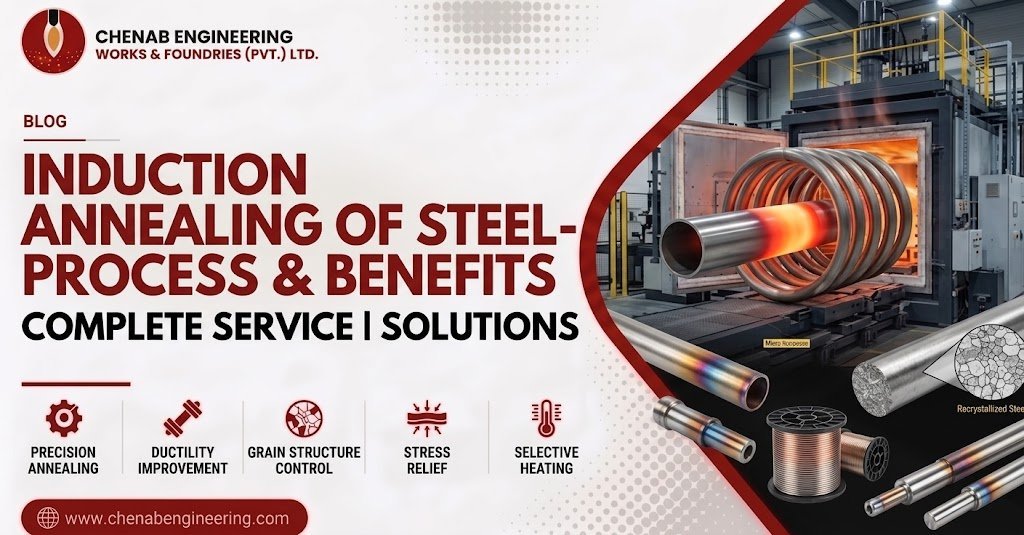
Induction annealing utilizes electromagnetic fields to generate localized thermal energy, a metallurgical. This thermal treatment softens specialized metals to improve subsequent machinability and mechanical ductility.
Controlled cooling relieves internal stresses from prior subtractive manufacturing operations, ensuring components consistently meet strict OEM specifications. We execute these precise processes maintain ISO 9001:2015 certification to guarantee standardized quality for engineering applications across countries. Understanding these thermal cycles remains critical for final component performance in demanding sectors.
The Engineering Science Behind Thermal Annealing
Thermal annealing requires heating metals above specific transformation temperatures. These temperatures often range between 600°C and 1100°C depending on the alloy. The heated component then undergoes a strictly controlled cooling phase. This slow cooling process relieves internal material stresses by up to 90%.
Electromagnetic induction provides rapid, localized heating for specific geometries. Conversely, sealed chamber environments ensure uniform heat distribution across 360 degrees. Both methods require precise temperature management within ±5°C.
Thermal engineers strictly control heating rates to optimize material properties. This precise control prevents cracking and severe part distortion.
Induction Coil Design and Frequency Selection
Induction annealing relies heavily on custom coil geometry. Engineers design specific copper coils to match component profiles within ±0.1mm tolerances. The coil generates a concentrated electromagnetic field around the workpiece. Frequency selection directly dictates the depth of heat penetration.
Higher frequencies above 100 kHz produce shallow heating depths. This suits thin wires and surface-level treatments perfectly. Lower frequencies below 10 kHz allow deeper thermal penetration. This is ideal for massive cross sections and large shafts. Operators calculate the skin effect to optimize energy transfer efficiently.
Material Metallurgy in Precision Annealing
Selecting the correct thermal cycle remains critical for component performance. Each specialized metal alloy requires distinct processing parameters. High-speed tool steels respond excellently to conventional thermal cycles. Precipitation-hardening stainless steels achieve excellent mechanical strength after solution annealing at 1040°C.
Specialized titanium alloys require specific stress-relieving environments. Technical documentation outlines exact temperature ranges between 790°C and 815°C for these alloys. Proper thermal processing ensures maximum secondary hardness or optimal ductility. Chenab Engineering applies these rigorous metallurgical standards consistently.
Microstructural Transformations During Annealing
Thermal annealing induces specific phase changes within the metal lattice. Heating above the recrystallization temperature of 700°C eliminates dislocation networks. This process replaces deformed grains with new, strain-free equiaxed grains. The material consequently regains its original ductility and softness.
Extended heating times can cause undesirable grain growth. Metallurgists strictly limit soak times to 30 to 60 minutes to prevent coarse grain formation. Controlled cooling rates further stabilize the refined microstructure. This meticulous control ensures predictable mechanical behavior in final applications.
Also read our article on Vaccum heat treatemnt.
Advanced Quenching and Cooling Technologies
Cooling methods dictate the final mechanical properties of annealed parts. High-pressure gas quenching represents an advanced cooling method. Systems utilize highly compressed inert gases like nitrogen at 10 to 20 bar pressure. This inert gas flows rapidly over the hot component.
The uniform gas flow extracts thermal energy efficiently. This method prevents the severe distortion associated with liquid quenching. Thermal engineers precisely control the gas pressure for optimal results. This optimization achieves target microstructures without compromising part integrity. Chenab Engineering documents these cooling parameters for full traceability.
Energy Efficiency and Environmental Impact
Induction annealing offers superior energy efficiency compared to traditional batch furnaces. The process generates heat directly within the conductive workpiece. This direct generation eliminates significant thermal losses associated with heating large chambers. Rapid heating cycles reduce total energy consumption to under 5 kWh per part.
The localized nature of induction minimizes overall facility heat generation. Operators utilize closed-loop water cooling systems for the induction coils. These systems recycle thermal energy and conserve valuable water resources. The process produces zero direct atmospheric emissions during operation.
Comprehensive Thermal Processing Capabilities
Advanced thermal facilities perform several distinct thermal cycles. Each specific process achieves unique mechanical properties for demanding applications. Vacuum hardening heats tool steels above critical transformation temperatures of 1000°C. This heating occurs in a completely oxygen-free environment.
The absence of oxygen prevents surface oxidation during heating. The heated component undergoes rapid high-pressure gas quenching. This rapid quenching achieves maximum material hardness within 5 to 10 seconds. The process creates a very hard martensitic microstructure. This microstructure forms uniformly throughout the entire material.
The popular tool steel grade D2 responds well to this process. It achieves exceptional wear resistance after proper hardening. Vacuum annealing softens specialized metals effectively. This softening improves subsequent machinability significantly. It also enhances overall mechanical ductility. Each component cools very slowly after full heating. This slow cooling occurs inside a sealed vacuum chamber. This controlled cooling relieves internal material stresses completely. It eliminates stresses from all prior subtractive manufacturing operations.
Vacuum brazing joins two distinct metal components reliably. This process utilizes a specialized filler metal alloy. The oxygen-free environment facilitates perfect metal flow.
The molten filler metal flows perfectly into all joints. This advanced joining process creates extremely strong assemblies. These mechanical assemblies remain completely leak-tight reliably.
Technical Note: Precision thermal processing requires strict thermal stability. Machine tools and fixturing must maintain consistent ambient temperatures.
Proper surface preparation remains absolutely critical before any thermal cycle. Operators thoroughly clean components using specialized ultrasonic aqueous cleaning systems. This process removes all residual machining oils and coolants.
Precision Metrology and Alloy Processing Specifications
Rigorous testing validates the success of every thermal cycle. Metrology equipment verifies post-process material hardness with ±0.5 HRC accuracy. Spectrographic analysis confirms material composition before processing begins. All testing equipment undergoes regular calibration by accredited laboratories.
Chenab Engineering maintains detailed specifications for major aerospace superalloys. The following table outlines standard processing parameters for common alloys. These values represent established industry benchmarks for thermal treatment. For complementary thermal processing insights, review our detailed guide on vacuum heat treatment.
| Alloy Grade | Processing Temperature | Primary Process | Hardness Achieved | Primary Applications |
| D2 Tool Steel | 1000 to 1050°C | Vacuum Hardening | HRC 58 to 60 | Stamping dies |
| M2 High Speed | 1180 to 1220°C | Vacuum Hardening | HRC 62 to 64 | Cutting tools |
| 17-4 PH Stainless | 1040°C | Solution Annealing | HRC 42 to 44 | Aerospace shafts |
| Ti-6Al-4V | 790 to 815°C | Stress Relieving | HRC 32 to 36 | Aircraft structures |
| Inconel 718 | 950 to 980°C | Solution Annealing | HRC 40 to 43 | Jet engine parts |
Industrial Applications of Annealed Components
Annealed components serve demanding industrial and aerospace applications. Aerospace shafts require precise solution annealing for optimal mechanical strength exceeding 1000 MPa. Aircraft structures utilize stress-relieved titanium alloys for extreme environments. Jet engine parts demand strict adherence to thermal processing specifications.
Stamping dies and cutting tools rely on precise hardening cycles. These processes ensure exceptional wear resistance and operational longevity. Chenab Engineering supports these demanding sectors with proven thermal expertise.
Pre-Cleaning and Surface Preparation Protocols
Proper surface preparation remains absolutely critical before thermal processing. Operators thoroughly clean every component before chamber loading. Specialized ultrasonic aqueous cleaning systems operate at 40 kHz frequencies to facilitate this preparation.
This ultrasonic process removes residual machining oils completely. It eliminates coolants from complex part geometries to a cleanliness level of < 5 mg/m². A clean surface ensures optimal thermal transfer and prevents contamination. This step guarantees the integrity of the final metallurgical structure.
Common Defects and Mitigation Strategies
Improper thermal processing can introduce severe metallurgical defects. Excessive temperatures above 1100°C cause surface oxidation and scale formation on ferrous alloys. Decarburization removes essential carbon from steel surfaces, reducing surface hardness. Uneven heating creates thermal gradients that lead to part warping.
Advanced facilities mitigate these risks through inert atmosphere shielding. Nitrogen or argon gas blankets prevent oxygen contact during heating. Real-time pyrometer monitoring ensures strict adherence to target temperature profiles within ±5°C. These safeguards guarantee dimensional stability and surface integrity.
Partnering for Metallurgical Excellence
Understanding thermal processing principles ensures superior component reliability. Precise temperature control and controlled cooling define successful annealing. Advanced facilities integrate these principles into every operational phase.
Chenab Engineering applies these exact standards to all thermal operations. Continuous monitoring and rigorous testing validate every processed batch with 100% traceability. This commitment ensures components meet exact engineering specifications reliably.
About the Author
Our facility manufactures precision-machined and thermally processed components for demanding industries. We integrate advanced CNC machining with specialized thermal treatment capabilities.
We produce high-tolerance parts with tolerances down to ±0.005mm for aerospace, defense, and industrial sectors globally. Our in-house engineering and metallurgical teams ensure every component meets strict OEM specifications. This integrated manufacturing approach delivers reliable, high-performance solutions for complex engineering applications.