
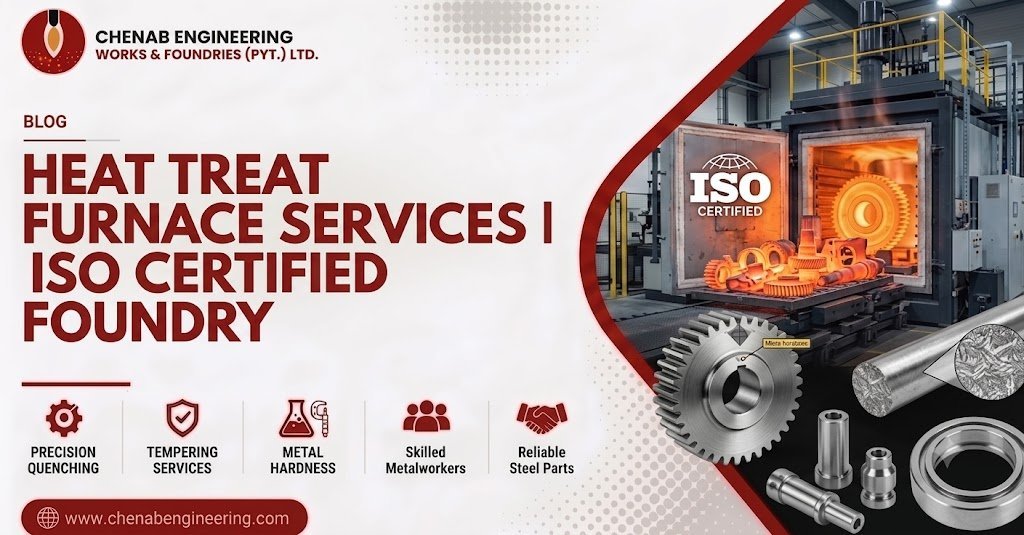
A heat-treat furnace alters the physical properties of metals through precisely controlled thermal cycles. This thermal processing equipment modifies microstructures to achieve desired mechanical characteristics in engineered components.
Chenab Engineering maintains ISO 9001:2015 and TÜV Austria-certified operations for consistent quality assurance. Engineers use these systems to increase hardness while maintaining dimensional stability across production batches.
The process also improves machinability and relieves internal residual stresses induced during prior manufacturing steps. The facility utilizes precise thermal cycles that are validated through rigorous metallurgical testing protocols.
This uniformity prevents part distortion and ensures repeatability across high-volume production runs daily. Thermal processing dates back to ancient blacksmithing techniques refined over centuries of observation.
Thermodynamics and Heat Transfer Principles
Thermal processing relies on fundamental heat transfer mechanisms, including conduction, convection, and radiation simultaneously. Conduction transfers heat directly through solid metal via atomic lattice vibrations and electron movement. Convection utilizes heated gases inside the chamber to surround and uniformly warm the load. Radiation emits thermal energy from electric or gas-fired heating elements toward the workpiece surface.
Engineers calculate specific heat capacities for each alloy to determine accurate energy input requirements. A standard batch unit consumes between 50 kW and 150 kW depending on load density. Temperature gradients must remain below ±5°C throughout the entire work zone volume continuously. This ensures uniform microstructural changes and prevents localized soft or hard spots in finished parts.
Thermal mass significantly affects the heating rate, especially in dense or thick cross-sections. Heavy loads, therefore, require longer soak times to achieve core temperature equilibrium before quenching. Heat loss occurs continuously through the chamber walls despite advanced insulation systems installed.
Types of Industrial Heating Equipment
Manufacturers design various furnace configurations to suit specific metallurgical and production volume requirements efficiently. Batch furnaces process discrete loads sequentially with manual or automated loading mechanisms for flexibility.
Continuous furnaces move parts on a conveyor through multiple temperature zones seamlessly for throughput. Box furnaces feature simple rectangular heating chambers ideal for general-purpose heat treatment tasks daily. A heat-treat furnace can be selected according to the required thermal processing application.
Car-bottom units handle extremely heavy loads by mounting the hearth on wheeled platforms securely. Vacuum models prevent oxidation during heating by evacuating air to pressures below 10⁻³ mbar. Chenab Engineering selects the optimal configuration based on part geometry, material type, and volume.
Material Metallurgy and Phase Transformations
Thermal cycling alters the crystalline structure of metals through controlled phase transformations under heat. Steel transforms from ferrite to austenite at specific critical temperatures defined by its composition. The eutectoid point occurs at exactly 727°C for plain carbon steels with 0.76% C. Rapid quenching forms hard martensite structures that provide high wear resistance in cutting tools.
Slow cooling produces softer pearlite formations consisting of alternating ferrite and cementite lamellae layers. Tempering reduces brittleness in hardened steels by allowing controlled carbide precipitation at lower temperatures. Chenab Engineering monitors these critical transformation points using calibrated thermocouples and digital data loggers. Quenching media choices directly affect the final hardness distribution and residual stress profile. Water quenching achieves maximum hardness levels but increases the risk of cracking significantly.
Quenching Media and Cooling Dynamics
The cooling phase dictates the final material properties more critically than the heating stage. Engineers select quenching media based on cooling severity measured by the Grossmann H-value accurately. Water provides the fastest cooling rates among common liquid quenchants used in industry today. Oil quenching reduces the risk of thermal shock and associated cracking in intricate geometries.
Polymer quenchants allow adjustable cooling speeds through concentration control and solution temperature management systems. Proper fluid circulation prevents vapor blanket formation that insulates hot surfaces from effective cooling. Parts must enter the quench tank immediately after reaching soak temperature for consistent results.
Precision Metrology and Temperature Control
Modern heat treat furnaces utilize advanced sensor arrays for real-time thermal monitoring and control. Type K thermocouples measure temperatures up to 1260°C with standard accuracy tolerances for steel. PID controllers adjust electrical or gas power dynamically to maintain exact setpoint temperatures continuously. Uniformity surveys verify chamber temperature consistency across all corners of the work zone annually.
The standard deviation must remain below ±3°C to meet aerospace and defense specifications strictly. AMS2750 defines strict aerospace pyrometry requirements for instrumentation, calibration, and uniformity testing protocols. Metrology labs calibrate all sensors annually against NIST-traceable reference standards for maximum accuracy. Digital data loggers capture real-time temperature profiles throughout each thermal cycle for full traceability. These records prove process compliance during third-party certification reviews and customer quality audits.
| Parameter | Specification | Tolerance |
| Maximum Temperature | 1200°C | ±5°C |
| Temperature Uniformity | ±3°C | AMS2750 |
| Thermocouple Type | Type K | Class 1 |
| Soak Time Variation | ±2 minutes | Automated |
The table outlines standard operational parameters used in certified thermal processing cells globally. Aluminum alloys require lower maximum temperatures, typically below 550°C, to avoid melting defects.
Post-Treatment Inspection and Hardness Testing
Engineers verify thermal results through rigorous destructive and non-destructive testing protocols after processing. Rockwell testing measures macro-hardness on large parts using standardized indenters and specific loads. Vickers testing provides precise micro-hardness data for thin case depths or small features. Metallographic examination reveals the internal microstructure after proper polishing and chemical etching steps.
Microscopes display grain size, phase distribution, and inclusion content at magnifications up to 1000x. Case depth measurements verify surface treatment success in carburized or nitrided components accurately. Technicians use micro-indentation traverses to map hardness gradients from surface to core accurately. Heat-treat furnace performance can also be evaluated through these metallurgical measurements.
Common Thermal Processing Defects and Prevention
Improper heating causes severe material defects that compromise mechanical performance and dimensional accuracy. Excessive temperatures lead to abnormal grain growth, which drastically reduces impact toughness. Rapid cooling creates dangerous internal residual stresses that may cause delayed cracking or warpage. Pre-heating reduces thermal gradients in thick sections before final austenitizing for operational safety.
Oxidation and decarburization ruin surface properties essential for fatigue and wear resistance applications. Engineers use controlled atmospheres with dew points below -40°C to prevent surface scaling. Soft spots indicate poor quench agitation or blocked fluid flow around complex geometries.
Environmental Controls and Atmosphere Management
Atmosphere control prevents unwanted chemical reactions between hot metal surfaces and furnace gases. Endothermic gases protect steel surfaces during heating by providing a reducing carbon potential. Nitrogen atmospheres prevent oxidation in bright annealing of stainless and specialty alloy components. Engineers monitor dew points continuously to ensure atmospheric dryness and prevent hydrogen embrittlement.
Vacuum furnaces eliminate the need for process gases by removing oxygen entirely from chambers. This approach produces exceptionally clean metal surfaces ready for plating without secondary cleaning. Pressure sensors maintain positive chamber pressure to prevent air infiltration during processing cycles.
Integration with Secondary Processes
Thermal processing often combines with other manufacturing steps in integrated production cells efficiently. Machining operations require softened materials, achieved through full annealing or normalizing cycles first.
Induction methods offer localized thermal treatment without affecting the entire component unnecessarily today. You can read more about induction annealing for surface softening prior to forming.
Normalizing refines the grain structure after forging to improve machinability and material homogeneity. Stress relieving removes residual machining stresses that could cause distortion during final assembly stages. Case hardening creates wear-resistant surface layers while maintaining a tough,h ductile core underneath.
Operational Parameters and Energy Efficiency
Energy consumption represents a major operational cost in thermal processing facilities worldwide today. Insulation materials minimize thermal radiation losses through multi-layer ceramic fiber modules rated highly. Modern units recover exhaust heat for preheating combustion air or incoming workpieces efficiently. Burner efficiency ratings exceed 90 percent in modern recuperative and regenerative gas-fired systems.
Chenab Engineering optimizes these energy parameters through regular combustion tuning and maintenance schedules. Load density directly impacts thermal efficiency since empty space wastes energy unnecessarily inside. Regular preventive maintenance ensures reliable equipment operation and prevents unexpected downtime events completely. Proper heat-treat furnace operation also supports efficient energy use during thermal processing.
Future Trends in Thermal Processing Technology
Industry 4.0 transforms traditional thermal processing through digital connectivity and data-driven decision-making. Internet of Things sensors monitor equipment health, including element resistance and fan vibration, remotely. Cloud platforms analyze real-time performance data to detect drift before it affects quality.
Predictive algorithms forecast maintenance requirements based on usage patterns and historical failure modes.
Digital twins simulate thermal cycles virtually before committing expensive materials to physical trials. Advanced automation reduces manual handling errors and improves operator safety in high-temperature zones. Machine learning algorithms optimize energy consumption by correlating load mass with power demand.
Summary of Thermal Processing Excellence
Thermal processing remains critical for achieving target material performance in engineered metal components. The equipment provides controlled microstructural modifications through precise time-temperature-transformation protocols every single cycle. Engineers rely on precise temperature management to ensure metallurgical consistency across global supply chains. Uniform heating prevents mechanical failures caused by mixed microstructures or residual stress concentrations.
Proper thermal cycles extend component service life by optimizing hardness, toughness, and fatigue resistance. Manufacturing engineers must understand these thermal principles to prevent costly field failures completely. Continuous technological improvements enhance furnace capabilities through better insulation, controls, and atmosphere management.
Reliable thermal equipment forms the manufacturing backbone for high-integrity metal components worldwide today. Advanced sensors ensure repeatable results through closed-loop feedback and real-time correction mechanisms.
Chenab Engineering continuously advances thermal processing science through collaboration between academia and industry.
About the Author
Our technical team includes certified metallurgists and thermal engineers. They have decades of experience in industrial heat treatment. They share practical knowledge about advanced thermal processing technologies. This covers quality control standards and material selection. They help businesses improve product performance and manufacturing reliability. This ensures operational efficiency across diverse industrial applications.