
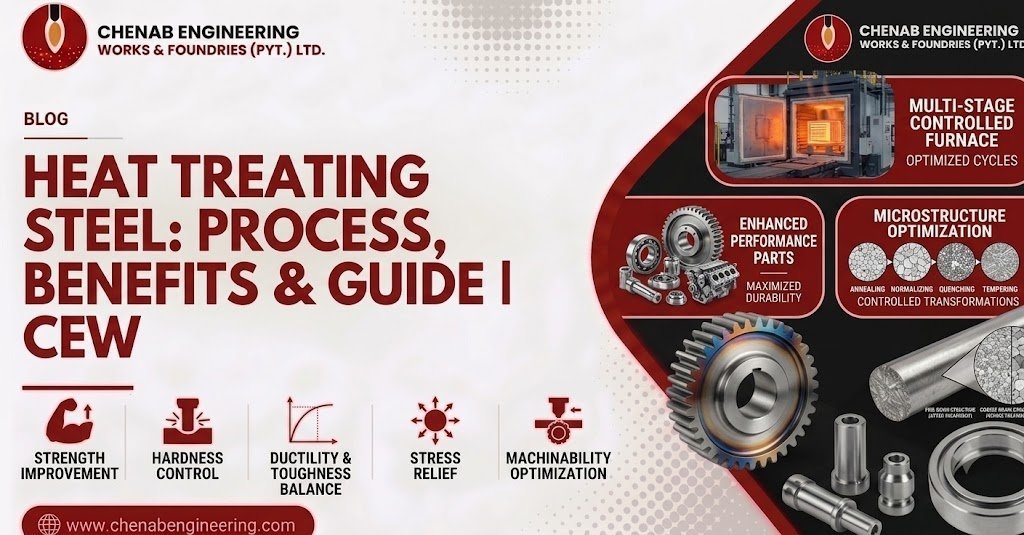
The controlled process of heat treating steel significantly alters physical material properties. Modern facilities operating under ISO standards strictly follow these precise thermal methodologies. Technicians utilize these microstructural transformations to meet strict OEM specifications consistently.
Chenab Engineering applies these exact thermal cycles to satisfy client's requirements. The iron-carbon phase diagram serves as the foundational map for these transformations.
Technicians rely on this diagram to determine the exact 900°C heating and cooling parameters. Understanding these fundamental metallurgical principles remains absolutely essential for modern manufacturing. Proper execution of these cycles ensures the final product meets all design requirements.
This scientific approach guarantees that every component performs reliably in its intended application. The entire process demands meticulous attention to precise temperature gradients and cooling rates. Failure to control these variables results in unpredictable material failures during operational use.
The Engineering Science Behind Heat Treating Steel
Thermal processing involves heating specific metal alloys to critical transformation temperatures precisely. The material enters an austenitic phase during this initial 850°C heating stage completely. Subsequent cooling rates dictate the final microstructural formation within the hardened steel component.
Rapid cooling produces hard martensite, while slow cooling yields much softer pearlite structures. Precise temperature control ensures consistent results across large industrial production batch sizes daily.
The eutectoid point occurs at approximately 0.76% carbon content in standard plain carbon steels. Alloys with lower carbon require different thermal strategies to achieve the desired overall hardness.
Advanced Thermal Processing Capabilities
Modern facilities utilize advanced computer-controlled atmosphere furnaces for precise thermal management systems. These systems prevent surface oxidation during extended 12-hour high-temperature heating cycles efficiently. Quenching mediums typically include specialized oils, polymers, or high-pressure gas cooling systems.
The subsequent metal tempering process reduces brittleness in the newly hardened martensite structures. Technicians carefully select tempering temperatures to balance hardness and structural toughness properly. This secondary heating step relieves internal stresses from the initial rapid quenching operation.
Vacuum furnaces provide exceptional surface quality for highly reactive aerospace alloy components. Deep cryogenic processing further transforms retained austenite into stable martensitic structures completely.
Material Metallurgy in Thermal Processing
Carbon content directly influences the maximum achievable hardness of the specific steel alloy. Low-carbon steels require case hardening to develop a highly wear-resistant surface layer effectively. High-carbon steel grades achieve extreme core hardness through direct quenching operations efficiently.
Alloying elements like chromium improve hardenability and thermal stability significantly at 5% concentrations. Nickel additions significantly enhance the core toughness of hardened steel structural components reliably. Vanadium forms fine carbides that restrict austenite grain growth during heating phases properly.
Our team selects specific thermal profiles based on these critical metallurgical variables accurately. Proper alloy selection ensures the material withstands highly demanding operational environments safely.
Precision Metrology and Quality Specifications
Quality control requires rigorous verification of mechanical properties after thermal processing is completed successfully. Technicians perform Rockwell hardness tests on every single production batch systematically and accurately. Advanced metallographic analysis confirms the presence of the desired microstructural phases precisely.
Dimensional inspections verify that thermal distortions remain within acceptable ±0.025mm engineering limits strictly. Advanced non-destructive testing methods identify subsurface defects without damaging the components physically. Magnetic particle inspection reliably reveals fine surface cracks in ferromagnetic steel parts.
| Material Grade | Austenitizing Temp (°C) | Quench Medium | Target Hardness (HRC) |
| 1045 Carbon Steel | 830 - 860 | Water / Oil | 50 - 55 |
| 4140 Alloy Steel | 840 - 870 | Oil | 45 - 52 |
| 4340 Alloy Steel | 830 - 860 | Oil | 50 - 55 |
| 300 Series Stainless | 1020 - 1120 | Water / Air | 70 - 90 HRB |
These strict parameters guarantee consistent performance across all manufactured industrial components globally. Comprehensive documentation accompanies every batch to ensure full traceability throughout the supply chain.
Industrial Applications of Thermally Processed Steels
The defense and aerospace sectors demand highly reliable thermally processed structural components constantly. Aircraft landing gear assemblies require extreme toughness from specialized tempering cycles. Automotive transmission shafts utilize induction hardening for localized surface wear resistance effectively.
Heavy machinery gears depend on carburizing to handle massive 5000 Nm torque loads reliably. We supply these critical informational parts to clients across 30+ countries globally. Tooling industries rely heavily on secondary hardening to maintain sharp cutting edges consistently.
Industrial bearing manufacturers depend on through-hardening to prevent premature fatigue failures completely. Axle shafts undergo specific thermal cycles to withstand severe torsional stresses reliably.
Process Economics and Energy Efficiency
Thermal processing represents a significant energy expenditure in modern manufacturing operations daily. Facilities optimize furnace loading to maximize energy efficiency per individual 500 kg production batch. Advanced refractory insulation materials reduce heat loss during extended austenitizing cycles efficiently.
Proper cycle programming minimizes overall energy consumption without compromising material properties severely. Efficient thermal management directly reduces the final cost of manufactured components substantially. Scrap rates decrease significantly when technicians maintain strict ±2°C temperature uniformity standards constantly.
Advancing Metallurgical Excellence in Manufacturing
Continuous improvement drives ongoing technological innovation within modern thermal processing facilities today. Our facilities maintain strict ISO 9001:2015 certification for all quality management systems globally. The operational teams also hold TÜV Austria certified status for overall excellence consistently.
These credentials validate our unwavering commitment to superior metallurgical engineering practices globally. Partnering with experienced thermal processors ensures optimal component performance and longevity reliably. The integration of digital monitoring systems provides real-time traceability for every batch produced.
Explore Our Technical Resources
You can explore our extensive technical resources right here on our website. Access detailed metallurgical data, specific process specifications, and comprehensive engineering guidelines. Please view our complete technical documentation for additional detailed engineering information.
About the Author
Certified metallurgists and senior thermal engineers lead our technical writing team. These experts possess over 25 years of direct industrial heat treatment experience. They specialize deeply in the metallurgical science of heat treating steel.
Their technical expertise covers strict quality control standards and precise material selection. These specialists help manufacturers improve component performance and overall structural reliability. This knowledge ensures operational efficiency across diverse global industrial applications.