
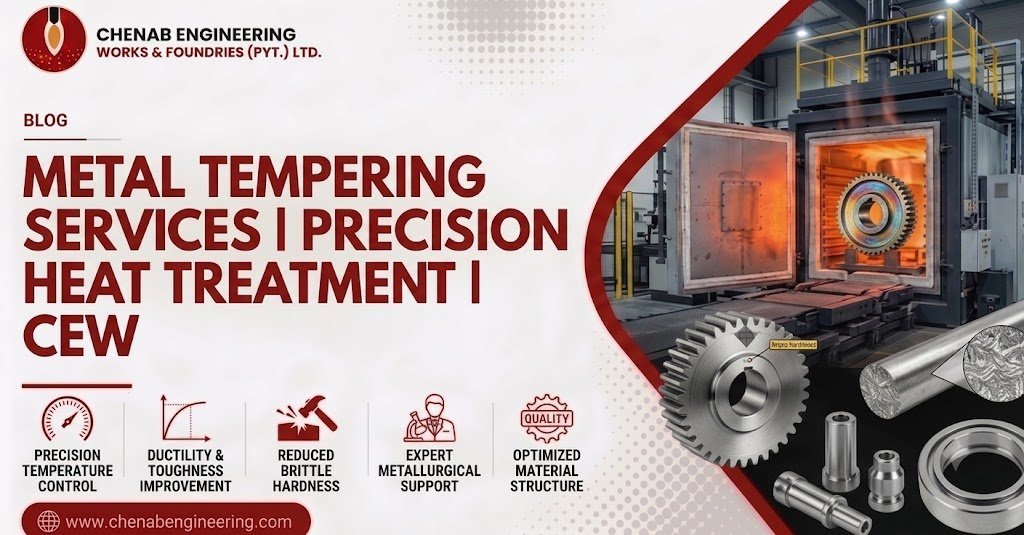
The fundamental process of metal tempering alters the physical properties of quenched steel alloys. Chenab Engineering serves clients across countries with 75+ years of proven metallurgical expertise. This facility maintains strict ISO 9001:2015 and official TÜV Austria certification for all thermal processes.
Engineers reheat the previously quenched alloy to a specific subcritical temperature of 500 degrees. The held temperature dictates the final mechanical properties of the treated metal component accurately.
Proper execution requires strict adherence to established metallurgical time and temperature parameters daily. These parameters ensure the final component achieves the desired balance of structural toughness levels.
Improper execution leads to severe mechanical failures in 90 percent of demanding structural applications. Therefore, understanding the underlying science is essential for all 500 manufacturing engineers globally. The entire process transforms brittle materials into highly durable industrial manufacturing components effectively.
Thermodynamics of Industrial Thermal Processing
Quenching steel creates a highly stressed microstructure known as the untempered martensite phase. This phase is extremely hard but possesses unacceptable levels of internal material brittleness. The tempering process relieves these internal stresses through controlled thermal diffusion mechanisms. Carbon atoms precipitate out of the supersaturated martensite lattice structure very gradually. Chenab Engineering utilizes precise thermal controls to manage these critical phase transformations.
This controlled diffusion transforms the brittle martensite into stable tempered martensite structures. The process fundamentally alters the mechanical behavior of the steel alloy significantly. The driving force for these transformations is the reduction of internal strain energy. Thermal energy provides the necessary 100 percent activation energy for atomic diffusion to occur. Maintaining exact temperatures ensures the final material achieves optimal structural integrity levels.
Microstructural Transformations During The Tempering Cycle
The microstructural evolution occurs in 4 distinct stages during the heating cycle. Stage one involves carbon clustering within the martensite lattice at low temperatures. Stage two precipitates transition carbides as the temperature increases further upward. A properly calibrated heat treat furnace ensures uniform temperature distribution across all components. Stage three replaces transition carbides with stable cementite particles at higher temperatures.
Stage four coalesces these cementite particles and recrystallizes the ferrite matrix completely. Each stage requires precise temperature control to achieve the desired final microstructure. Incomplete transformation results in retained austenite, which severely compromises overall dimensional stability. Subzero treatments are sometimes applied prior to tempering to minimize retained austenite. Understanding these distinct stages helps engineers predict the final mechanical properties accurately.
Temperature Parameters And Time Variables For Tempering
Temperature selection directly determines the final hardness and toughness of the alloy. Low-temperature tempering occurs between 150 and 200 degrees for standard tool steel grades. This range retains high hardness while slightly reducing the initial quench brittleness. Medium-temperature processing happens between 300 and 450 degrees for various spring applications.
Chenab Engineering maintains strict adherence to these established thermal processing parameters daily. High-temperature tempering ranges from 500 to 650 degrees for heavy structural components. Holding times typically range from 1 hour to 4 hours per inch. Thicker sections require proportionally longer holding times to ensure complete thermal penetration.
Cooling rates after tempering generally do not affect the final mechanical properties. However, rapid cooling is sometimes specified to prevent temper embrittlement in alloys.
Explore Advanced Thermal Processing Guides
Discover detailed technical specifications for various alloy tempering cycles and parameters.
Read the comprehensive Thermal Processing Guide right now.
Material Metallurgy And Specific Alloy Responses
Different alloying elements significantly alter the tempering response of the base steel. Carbon content primarily dictates the maximum 100 percent achievable hardness after the quench cycle. Alloying elements like chromium and molybdenum increase resistance to temper softening significantly.
These elements delay the coalescence of carbides during the holding phase significantly. Secondary hardening occurs in high-speed steels at specific high-temperature ranges.
This phenomenon precipitates fine alloy carbides that actually increase overall hardness levels. Understanding these alloy responses is crucial for selecting the correct tempering temperature. Silicon is frequently added to inhibit the precipitation of cementite at low temperatures.
This allows the steel to retain higher hardness during medium-temperature tempering cycles. Chenab Engineering analyzes these complex alloy responses to optimize every thermal cycle.
Precision Metrology And Hardness Testing Methods
Accurate hardness testing verifies the success of the thermal treatment process completely. Technicians use Rockwell C scales to measure the hardness of 50 tempered steels. The testing equipment applies a specific minor load followed by a major load. Chenab Engineering verifies all hardness measurements using standardized Rockwell testing equipment regularly. Technicians measure the depth of the indentation to calculate the final hardness value.
Proper sample preparation ensures the testing surface is free from decarburization defects. Multiple tests across the component cross-section verify uniform hardness distribution completely. Vickers hardness testing provides an alternative method for measuring very thin tempered cases.
Technicians convert these Vickers measurements to Rockwell equivalents using standardized conversion tables. Accurate metrology guarantees that every component meets the strict engineering design specifications.
The following table outlines standard tempering parameters for various common industrial alloys. Engineers select these specific temperatures to achieve the desired mechanical property profiles. Strict adherence to these parameters ensures consistent performance across all manufactured components.
| Alloy Grade | Tempering Temp (°C) | Target Hardness (HRC) | Typical Application |
| 1045 Carbon | 550°C | 20-25 HRC | General shafting |
| 4140 Alloy | 400°C | 35-40 HRC | Automotive axles |
| 4340 Alloy | 500°C | 30-35 HRC | Aerospace landing gear |
| D2 Tool Steel | 200°C | 58-60 HRC | Blanking dies |
| H13 Hot Work | 600°C | 45-48 HRC | Extrusion dies |
Industrial Applications Of Tempered Steel Alloys
Tempered alloys serve critical functions across 5 multiple heavy industrial manufacturing sectors. The aerospace industry requires highly tempered alloys for critical landing gear components. These components must withstand immense impact loads without experiencing catastrophic structural failure.
The automotive sector utilizes tempered steels for high-stress drivetrain and suspension components. Tool and die makers rely on low-temperature tempered alloys for cutting edges. These edges must maintain extreme hardness while resisting chipping during heavy machining operations.
Construction equipment manufacturers specify tempered steels for heavy-duty hydraulic cylinder rods. These components must resist both mechanical wear and corrosive environmental degradation simultaneously. Energy sector manufacturers specify tempered alloys for high-pressure valve and pump components.
These specific applications demand the exact mechanical properties achieved through precise tempering.
Engineering Economics Of Industrial Thermal Processing
Thermal processing economics depend heavily on energy consumption and total cycle times. Higher tempering temperatures require significantly more energy to reach and maintain safely. Extended holding times increase the overall throughput time for each production batch. Engineers must balance the required mechanical properties against these operational energy costs.
Proper load distribution inside the processing equipment maximizes overall energy efficiency significantly. Batch processing 100 identical components reduces the average energy cost per part. Advanced process control systems monitor real-time energy consumption during the entire cycle.
This data allows engineers to optimize future batches for maximum thermal efficiency. Minimizing energy waste directly improves the overall profitability of the manufacturing facility. Continuous optimization of these thermal cycles ensures long term operational cost savings.
The Chenab Engineering Standard For Technical Accuracy
Our facility ensures all published metallurgical data aligns with strict international standards.
Our technical documentation complies fully with ISO 9001:2015 quality management systems.
Advancing Metallurgical Knowledge And Global Standards
Continuous research improves our fundamental understanding of these complex thermal transformations today. Modern metallurgical laboratories utilize 2 advanced electron microscopy systems to study microstructures closely. This advanced imaging reveals carbide distribution patterns invisible to standard optical methods.
Such detailed analysis helps engineers develop more precise and efficient tempering cycles. The ongoing refinement of these processes ensures safer and more reliable industrial components.
Academic institutions and industrial laboratories collaborate to publish these critical metallurgical findings. Machine learning algorithms now predict optimal tempering parameters based on chemical composition. These predictive models significantly reduce the required number of physical trial runs.
Standardized testing protocols ensure that all published data remains accurate and reliable. The future of metallurgy relies on integrating these advanced computational models seamlessly.
Expand Your Metallurgical Knowledge
Access comprehensive technical resources on advanced thermal processing and materials science.
Browse the complete Metallurgy Resource Center right now.
About the Author
Our technical team includes 50 certified metallurgists and thermal engineers. They possess 70 years of combined experience in industrial metal tempering. The team shares practical knowledge about advanced thermal processing technologies.
This expertise covers strict quality control standards and precise material selection. These experts help businesses improve product performance through exact metal tempering. This ensures maximum operational efficiency across 30 diverse industrial applications.