
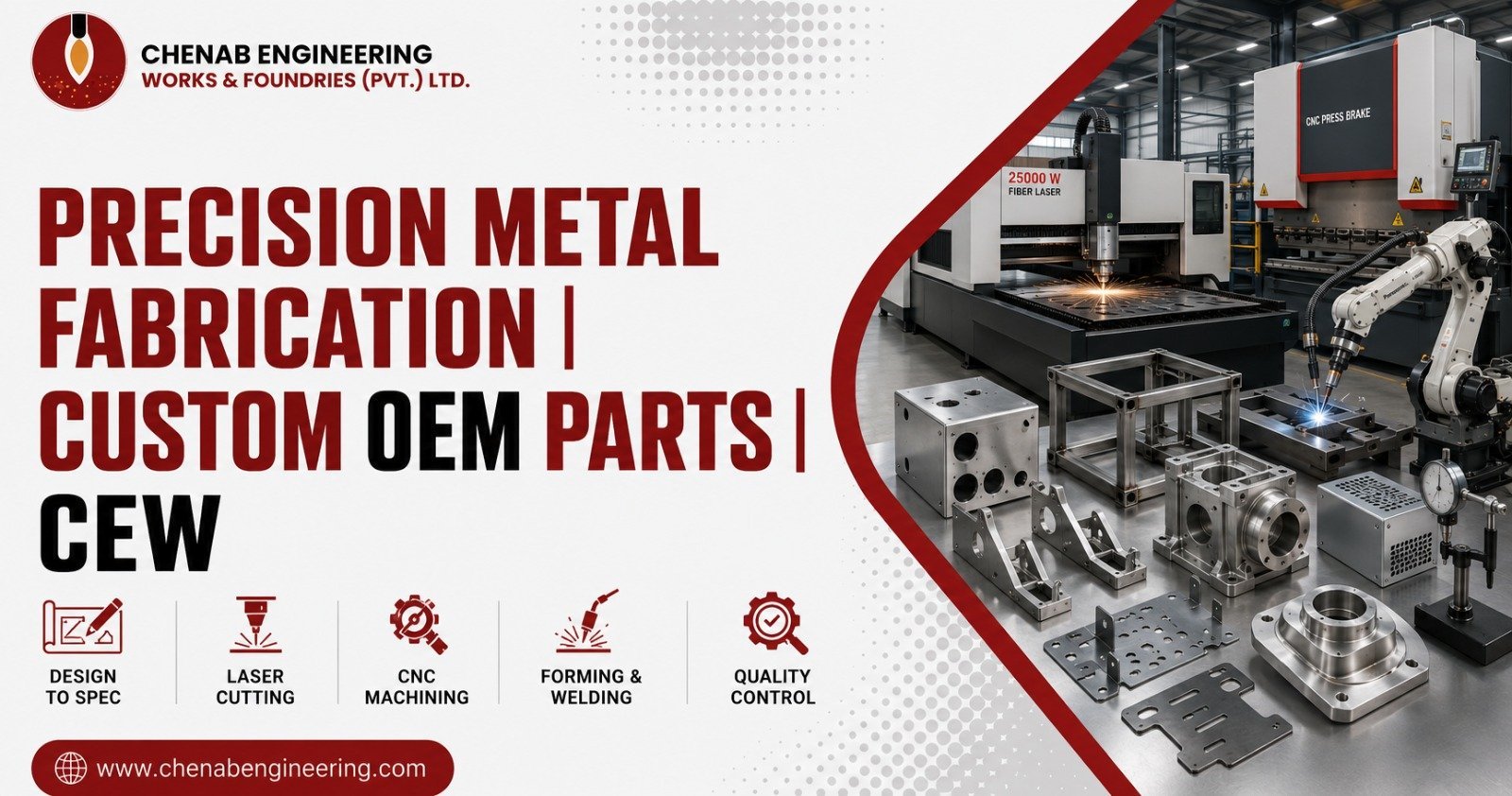
When businesses need accurate, durable, and production-ready components, precision metal fabrication services provide a dependable manufacturing solution.
With 70+ years of engineering experience, Chenab Engineering serves industrial customers across countries worldwide. Its integrated capabilities include casting, CNC machining, heat treatment, surface finishing, and custom OEM component manufacturing. These services help procurement teams source high-quality parts with controlled ±0.025mm tolerances, suitable materials, and dependable delivery support.
Reliable Fabrication for Demanding Industrial Applications
Combines engineering expertise, modern machining, and controlled manufacturing processes. Its capabilities support agricultural machinery, industrial equipment, construction machinery, and replacement-part manufacturers.
The company provides design support, pattern development, casting, CNC machining, heat treatment, and quality inspection. This integrated approach reduces supplier coordination, improves traceability, and supports consistent production outcomes.
For buyers, the main advantage is one-source manufacturing. Engineering teams can manage prototypes, tooling, production components, and inspection documentation through one coordinated workflow.
Custom OEM Parts Built Around Your Requirements
Every industrial component has specific requirements for geometry, material, strength, surface quality, and operating conditions. A dependable supplier must understand these requirements before production begins.
Works from OEM drawings, customer samples, technical specifications, and approved prototypes. Its engineering team can support CAD/CAM development, pattern preparation, reverse engineering, and production planning.
This process helps identify manufacturing risks before tooling or machining begins. It also allows buyers to confirm critical dimensions, tolerances, materials, and finishing requirements early.
For precision components, dimensional control can reach ±0.025mm, depending on the part design, machining method, and inspection plan. Angular features may require a ±0.5° tolerance for proper assembly and dependable field performance.
These tolerances are especially valuable for housings, mounting surfaces, shafts, covers, hubs, brackets, and interconnected machinery components. Accurate dimensions help prevent premature wear, alignment problems, vibration, and costly assembly delays. Precision metal fabrication also helps maintain consistent dimensions across different parts and production requirements.
Material Selection for Performance and Service Life
Choosing the correct material affects strength, corrosion resistance, weight, machinability, and long-term reliability. The right grade should always match the component’s working environment and loading conditions.
Stainless steel grades 304 and 316 are suitable for many corrosion-resistant applications. Grade 316 offers improved resistance in demanding environments involving moisture, chemicals, or salt exposure.
For lightweight, high-strength parts, aluminum 7075 can support applications requiring excellent strength-to-weight performance. It is commonly considered for aerospace, tooling, fixtures, and specialized mechanical components.
Titanium Ti-6Al-4V offers high strength, low density, and strong corrosion resistance. It may suit advanced applications where performance justifies higher material and machining costs.
Material selection should include more than the grade name. Buyers should confirm thickness, heat-treatment condition, mechanical properties, surface requirements, and applicable inspection documentation.
Controlled Machining and Surface Finishing
After casting, forming, or cutting, CNC machining can produce the final dimensions required for assembly. Controlled toolpaths support repeatability across prototypes and larger production batches.
Critical sealing or mating surfaces may require a fine finish, such as Ra 0.8 μm. More demanding contact surfaces can require Ra 0.4 μm, subject to design and inspection requirements.
Surface finish affects sealing performance, friction, wear, appearance, and component cleanliness. It also influences how reliably parts perform when exposed to movement, pressure, heat, or contamination.
A professional supplier should connect machining parameters with the customer’s functional requirements. This prevents unnecessary finishing costs while protecting the surfaces that directly affect performance.
Heat Treatment and Hardness Control
Some components require increased surface hardness, wear resistance, or improved structural strength. Heat treatment can help achieve these characteristics when applied according to the material specification.
Depending on the component and process, finished parts may require hardness above HRC 50+. Other applications may specify a softer range, such as HRB 70–85, for improved machinability or controlled material behavior.
Hardness requirements should never be selected separately from the design. Engineers must consider load, impact, wear, section thickness, machining sequence, and expected operating conditions.
Chenab Engineering supports heat treatment, hardening, and tempering as part of its broader manufacturing workflow. These services help customers manage performance requirements without coordinating separate external suppliers.
From Prototype to Production Quantities
A reliable manufacturing partner should support different purchasing stages. Prototype development, pilot production, aftermarket supply, and high-volume manufacturing each require different planning methods.
Can support projects ranging from individual prototype samples to production orders exceeding 10,000 units monthly. Aftermarket buyers may also benefit from flexible minimum quantities starting around 50 pieces per part number.
Production planning typically includes tooling review, material confirmation, machining strategy, inspection points, packaging, and delivery schedules. Clear planning helps reduce surprises after purchase orders are released.
Standard catalog products may ship within approximately 2–4 weeks. Custom components commonly require 4–8 weeks, depending on complexity, tooling, material availability, and order volume.
These timelines should be confirmed during quotation because complex assemblies may require additional testing or customer approval. Early drawing submission can help shorten unnecessary communication and approval delays.
Quality Assurance That Supports Confident Purchasing
Quality control should continue throughout manufacturing rather than beginning during final dispatch inspection. Early checks help identify problems before they affect complete production batches.
The company’s quality workflow includes material verification, dimensional inspection, hardness testing, tensile testing, and spectrometry analysis. These controls help confirm that parts meet the agreed technical requirements.
Inspection planning can focus on critical dimensions, hole locations, datum surfaces, wall thickness, hardness, finish, and material composition. This creates a practical quality record for procurement and engineering teams.
For export orders, customers may also request material certificates, inspection reports, packaging details, and shipping documentation. Confirming these requirements before production helps avoid documentation delays in precision metal fabrication.
Products and Industries Supported
Chenab Engineering manufactures components for tractors, construction machinery, industrial systems, and other demanding applications. Its listed product range includes Hub Front Wheel 240, Adopter Plate, and Cap Lift Cover.
The company also supplies cast iron components such as axle housings, front supports, differential cases, hydraulic lift covers, and rear hubs. These parts support machinery requiring strength, durability, and dependable dimensional control.
Its foundry capabilities include gray iron and ductile iron castings. Production can combine casting with CNC machining, heat treatment, and laboratory testing for a more complete supply solution.
Buyers seeking stainless or non-ferrous components can discuss grades such as 304, 316, 7075, or Ti-6Al-4V during technical review. Final availability depends on drawings, quantities, process suitability, and approved specifications.
For customers requiring more specialized sheet work, explore stainless steel sheet fabrication for an additional fabrication-focused solution.
Why Choose Chenab Engineering for OEM Supply?
Selecting the right supplier requires more than comparing unit prices. Buyers should evaluate technical capability, inspection strength, communication, delivery reliability, and export experience.
Chenab Engineering offers an integrated manufacturing process from design development through finished machining. This structure can reduce handoffs and improve accountability across the complete order cycle.
Its TÜV Austria certification and ISO 9001:2015 quality approach provide a strong foundation for controlled manufacturing. Customers can also discuss inspection plans for tolerances, surface finishes, hardness, and material grades.
The company has served international customers across 30+ countries, including markets in Africa, the Middle East, Southeast Asia, and South America. Export support includes documentation assistance and FOB or CIF shipping terms.
Technical Capability Overview
| Requirement | Available Specification or Support | Typical Application |
| Dimensional tolerance | ±0.025mm | Precision-machined mating features |
| Angular tolerance | ±0.5° | Brackets, housings, and angled components |
| Surface finish | Ra 0.8 μm | Sealing and general contact surfaces |
| Fine surface finish | Ra 0.4 μm | High-precision mating surfaces |
| Higher hardness | HRC 50+ | Wear-resistant components |
| Controlled hardness | HRB 70–85 | Machinable structural components |
| Stainless steel | 304 and 316 | Corrosion-resistant equipment |
| Aluminum alloy | 7075 | Lightweight high-strength parts |
| Titanium alloy | Ti-6Al-4V | Advanced strength-to-weight applications |
Specifications depend on approved drawings, material condition, production method, and inspection requirements. Engineering confirmation should happen before quotation approval.
Request a Detailed Manufacturing Quote
A strong quotation begins with complete technical information. Send drawings, three-dimensional files, samples, annual quantities, materials, tolerances, finishes, and delivery expectations.
Mention any required inspection reports, certificates, packaging standards, or export documentation. This allows the engineering team to calculate tooling, machining, testing, and logistics costs accurately.
For custom production, ask for a clear breakdown covering unit price, tooling charges, minimum order quantity, lead time, payment terms, and shipping options. A transparent quotation makes supplier comparison easier.
Our technical team can review your requirements and recommend a practical manufacturing route. It can also identify opportunities to simplify production without compromising important performance features.
Final Thought
The right supplier makes custom manufacturing easier, more predictable, and commercially valuable. Integrated production, documented quality systems, global service experience, and flexible order support can help transform technical drawings into dependable industrial components through precision metal fabrication.
Share your drawings, material requirements, quantities, and target delivery date today. The engineering team can review your project and prepare a practical quotation.
About the Author
This article was prepared for industrial buyers researching OEM components, CNC machining, casting, and fabrication suppliers. Information reflects the manufacturing capabilities and product details presented by Chenab Engineering Works.