
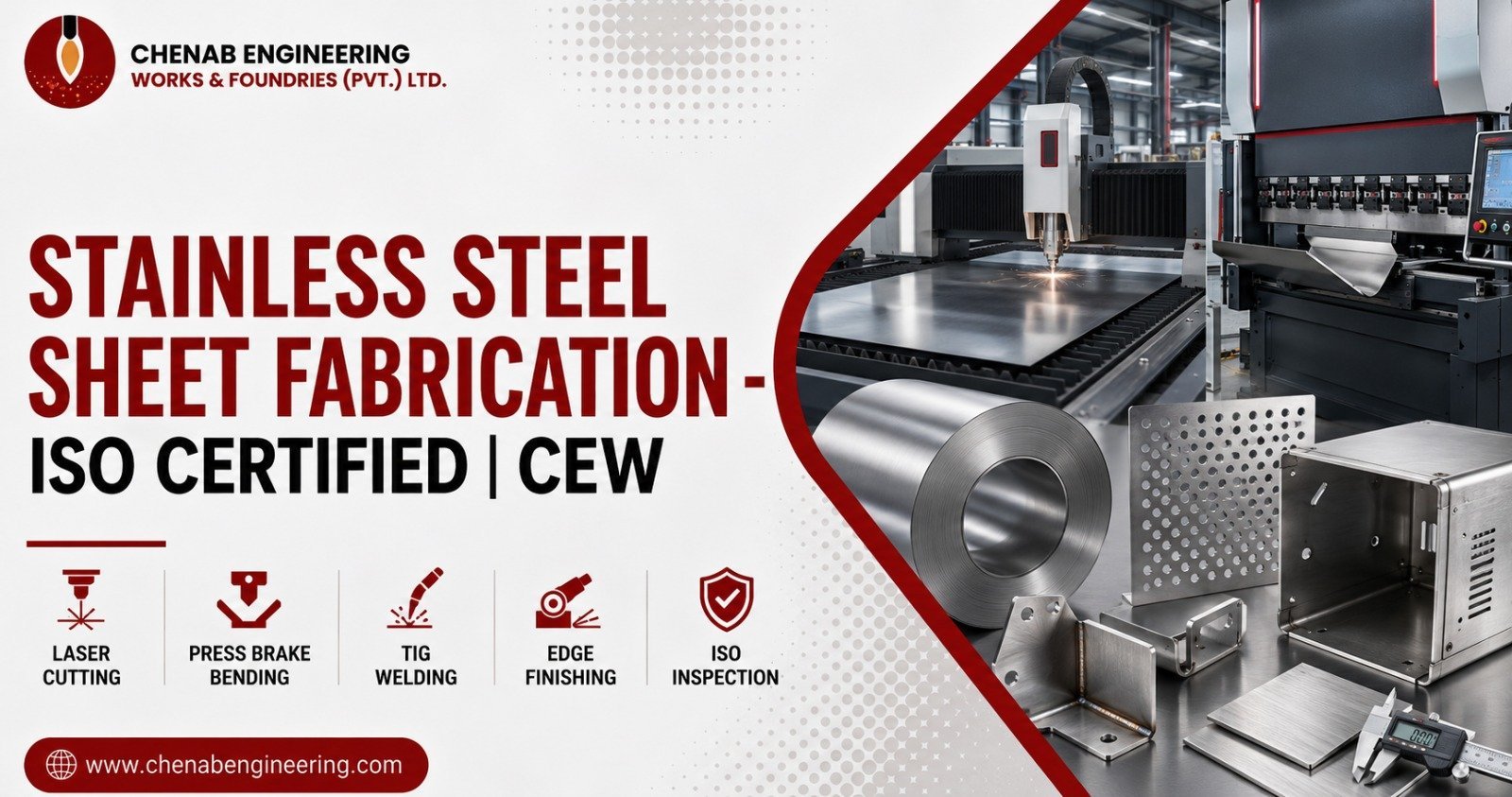
Modern manufacturers require exceptional ±0.01mm dimensional precision constantly. Chenab Engineering delivers high-quality stainless steel sheet fabrication for demanding commercial projects reliably. We operate as a TÜV Austria-certified manufacturing partner with strict ISO 9001:2015 compliance. We successfully export precision-engineered components to commercial clients across countries.
Technicians utilize advanced computer-controlled machinery to cut complex metal geometries accurately. This commercial manufacturing process ensures optimal material utilization and minimal waste consistently. Fabrication teams strictly follow exact engineering blueprints for every custom component order. We maintain rigorous dimensional accuracy across large-scale industrial production batches daily. Commercial buyers demand absolute reliability from their manufacturing partners consistently.
The Engineering Science Behind Metal Fabrication
Advanced fabrication processes alter physical material properties to meet strict commercial specifications. Thermal cutting methods utilize 4000W high-energy lasers to sever thick metal plates cleanly. Computer numerical control systems guide cutting tools along precise, programmed pathways accurately.
These automated systems eliminate human error during complex commercial manufacturing operations completely. Precision cutting prevents material warping during subsequent fabrication stages effectively.
Mechanical bending operations apply calculated force to form specific angular geometries precisely. Press brakes utilize specialized tooling to achieve exact bend radii consistently. Sheet metal fibers undergo plastic deformation without experiencing structural cracking or failure.
Engineers calculate precise springback values to ensure final dimensional accuracy reliably always. Digital simulations verify bending sequences before physical execution begins.
Advanced Capabilities For Precision Manufacturing
Chenab Engineering facilities operate 5-axis machining centers to mill intricate features efficiently. Technicians drill precise hole patterns to accommodate complex mechanical assembly requirements accurately. Automated welding systems join individual metal components using controlled electrical arcs perfectly.
These advanced joining methods create exceptionally strong structural bonds across commercial assemblies. Integrated manufacturing workflows eliminate the need for multiple external vendors.
Fabrication teams often apply specific thermal cycles to relieve internal welding stresses. You can explore our detailed thermal processes through our comprehensive heat-treating steel guidelines. This secondary processing step significantly improves the overall mechanical toughness reliably and always.
Commercial buyers benefit from these integrated manufacturing capabilities for complex industrial projects. Dedicated engineers oversee every production phase to guarantee absolute quality.
Require High-Precision Machined Components?
Get a detailed technical quote from our engineering team within 24 hours.
Material Metallurgy In Precision Manufacturing
Material selection directly influences the commercial viability and longevity of stainless steel sheet fabrication structures. 316L austenitic grades provide exceptional corrosion resistance for harsh chemical processing environments effectively.
Ferritic alloys offer superior structural strength for heavy-duty commercial construction applications reliably. Procurement teams source certified raw materials from trusted global metallurgical suppliers exclusively. Material hardness directly impacts the tooling wear rates during fabrication.
Spectroscopic analysis verifies exact chemical compositions before fabrication operations commence. This strict verification process prevents material mix-ups during large-scale commercial production runs. Engineers select specific alloy grades based on precise operational load requirements.
Optimal material selection guarantees long-term structural reliability for demanding industrial applications consistently. Comprehensive mill certificates accompany every single raw material shipment globally.
Technical Note: Precision commercial fabrication requires strict ±1°C thermal stability constantly. Advanced machine tools must maintain consistent 20°C ambient temperatures accurately globally.
Precision Metrology Specifications
Quality control inspectors utilize CMM coordinate measuring machines to verify complex geometries accurately. These advanced metrology tools capture thousands of dimensional data points rapidly. Inspectors compare physical measurements against the original digital computer-aided design models strictly.
This rigorous verification process ensures absolute compliance with tight engineering tolerances. Regular calibration of all measuring equipment ensures ongoing measurement accuracy.
Surface profilometers measure microscopic roughness values to guarantee optimal commercial finish quality. Technicians perform non-destructive testing to identify hidden internal structural defects reliably. Magnetic particle inspection reveals fine surface cracks in highly stressed ferromagnetic components.
Comprehensive inspection reports accompany every single commercial shipment for complete supply chain traceability. Digital records store all inspection data for future commercial reference.
| Material Grade | Thickness Range (mm) | Tolerance (±mm) | Surface Finish (Ra μm) |
| 304 Stainless | 0.5 – 12.0 | ±0.05 | 1.6 |
| 316 Stainless | 1.0 – 15.0 | ±0.05 | 0.8 |
| 430 Stainless | 0.5 – 10.0 | ±0.10 | 3.2 |
Industrial Applications Of Custom Fabricated Parts
The defense and aerospace sectors demand highly reliable fabricated structural components constantly. Aircraft manufacturers utilize precision-formed panels for critical aerodynamic fuselage assemblies efficiently. Military vehicle producers require heavily armored enclosures that withstand extreme ballistic impacts.
These critical commercial applications demand uncompromising manufacturing quality and absolute structural integrity. Rigorous testing validates every component before final deployment in the field.
Heavy construction machinery relies on durable fabricated chassis components for demanding operations. Agricultural equipment manufacturers utilize corrosion-resistant metal housings for harsh outdoor environments reliably. We supply these critical commercial parts to clients across countries globally.
Marine engineering projects utilize specialized corrosion-resistant alloys for critical offshore structures. Our commercial fabrication services directly support massive global infrastructure development projects continuously.
Engineering Economics Of Precision Machining
Commercial fabrication represents a significant capital expenditure for modern industrial manufacturing operations. Facilities optimize raw material nesting to maximize overall 95% commercial yield efficiently. Advanced software algorithms calculate the most cost-effective cutting pathways automatically and accurately.
This automated optimization directly reduces the final commercial cost of manufactured components. Reduced energy consumption also lowers the overall carbon footprint of production.
Efficient production scheduling minimizes machine idle time during complex commercial manufacturing runs. Proper toolpath programming extends cutting tool life and reduces operational consumable expenses. Scrap rates decrease significantly when technicians maintain strict operational temperature uniformity standards.
These economic efficiencies provide substantial commercial advantages for large-scale industrial procurement teams. Long-term partnerships foster continuous process improvements and sustained commercial cost reductions.
Strategic Supply Chain Advantages
- Global Logistics And Export Compliance
International shipping requires meticulous documentation and strict adherence to complex customs regulations. Our logistics team manages all export paperwork to prevent costly commercial delays. We utilize specialized crating to protect precision components during the transit of international stainless steel sheet fabrication safely.
This careful handling ensures parts arrive at global facilities in perfect condition. Customs brokers facilitate smooth border crossings for all international shipments.
- Scalable Production Volumes For OEMs
Original equipment manufacturers require consistent supply chains for continuous assembly line operations. Our facility scales production volumes seamlessly to match fluctuating commercial demand cycles. Dedicated inventory management systems track raw materials and finished goods accurately.
This scalability guarantees uninterrupted manufacturing operations for our global commercial partners. Flexible scheduling accommodates urgent commercial orders without disrupting standard production.
Advanced Surface Engineering Techniques
- Electropolishing And Passivation Protocols
Surface engineering significantly enhances the functional lifespan of fabricated commercial components. Electropolishing removes microscopic surface imperfections to create a perfectly smooth metallic finish. Subsequent passivation treatments maximize the natural corrosion resistance of stainless steel alloys.
These combined processes ensure superior performance in highly aggressive chemical environments. Chemical baths remove free iron particles from the metal surface effectively.
- Protective Coating Applications
Specialized industrial coatings provide additional barriers against extreme environmental degradation factors. Powder coating applications deliver uniform protective layers with exceptional mechanical durability. Technicians apply these coatings using electrostatic spray methods for maximum adhesion.
This final surface treatment step guarantees long-term aesthetic and structural preservation. Curing ovens ensure complete chemical bonding of the protective layers.
Custom Tooling And Prototype Development
- Rapid Prototyping For Commercial Validation
Rapid prototyping accelerates the commercial validation phase for new industrial products. Our engineers fabricate functional prototypes using exact production-grade materials and processes. This approach identifies potential design flaws before committing to high-volume manufacturing.
Clients receive tangible proof of concept within strict commercial project timelines. Iterative testing refines the design for optimal mechanical performance.
- High-Volume Production Tooling
High-volume production requires robust, durable tooling to maintain consistent part quality. We design and manufacture custom dies, jigs, and fixtures in-house. This internal capability significantly reduces lead times for complex commercial fabrication orders.
Durable tooling ensures dimensional stability across millions of production cycles. Computer simulations verify tooling designs before physical manufacturing begins.
Quality Assurance And Traceability Standards
- Comprehensive Material Certification
Every raw material batch arrives with comprehensive mill test certificates. These critical documents verify the exact mechanical properties of the supplied metals. Procurement teams review these certificates before authorizing any commercial fabrication operations.
This strict documentation process ensures absolute material traceability throughout the entire supply chain. Auditors regularly verify our documentation practices for ongoing compliance.
- Non-Destructive Testing Protocols
Non-destructive testing evaluates component integrity without causing any physical damage. Ultrasonic testing detects internal voids or inclusions within thick metal sections. Dye penetrant inspection reveals microscopic surface-breaking defects on critical weld joints.
These rigorous protocols guarantee absolute safety and reliability for end-users. Certified inspectors document all findings in detailed commercial-quality reports.
Partnering For Precision Manufacturing Excellence
Continuous improvement drives ongoing technological innovation within modern stainless steel sheet fabrication facilities globally. Our operational teams maintain strict ISO 9001:2015 certification for all quality systems. The manufacturing facilities also hold TÜV Austria certified status for overall excellence.
These credentials validate our unwavering commitment to superior commercial engineering practices. Dedicated account managers serve as the primary technical liaison for clients.
Partnering with experienced commercial fabricators ensures optimal component performance and longevity. The integration of digital monitoring systems provides real-time traceability for every batch. Our dedicated project managers oversee every commercial fabrication order from inception to delivery.
They provide regular progress updates and resolve any manufacturing challenges immediately. We invite commercial procurement teams to discuss their specific industrial requirements.
Require High-Precision Fabricated Components?
Get a detailed technical quote from our engineering team within 24 hours.
About the Author
Certified metallurgists and senior fabrication engineers lead our technical writing team. These experts possess over 25 years of direct industrial manufacturing experience. They specialize deeply in the metallurgical science of commercial stainless steel sheet fabrication processes.
Their technical expertise covers strict quality control standards and precise material selection. They help manufacturers improve component performance and overall structural reliability.