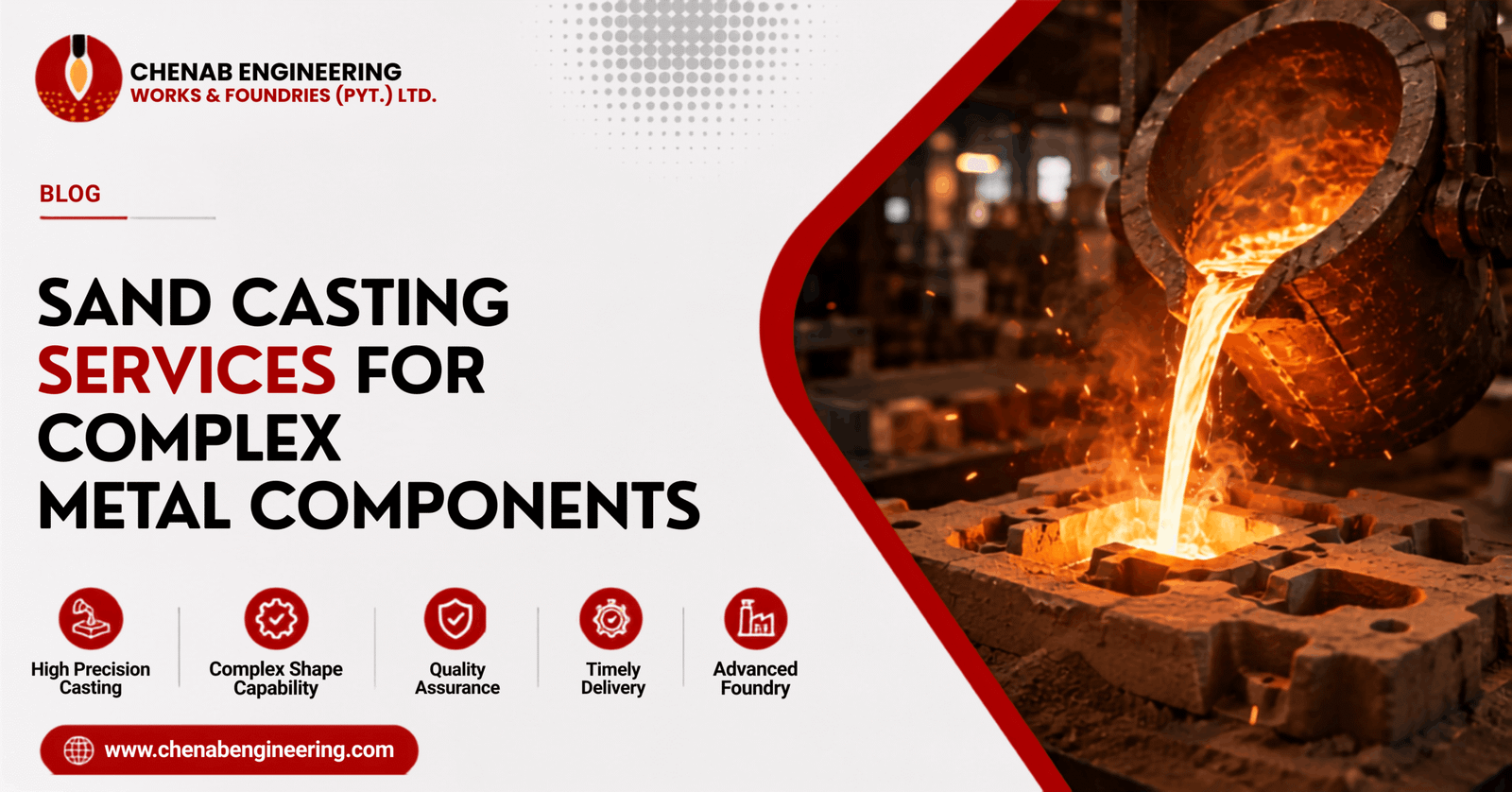
Foundries globally struggle with inconsistent porosity and dimensional drift in heavy castings. Sand casting services resolve these critical manufacturing challenges through precise thermal control. Chenab Engineering masters this complex metallurgical process daily, producing high-integrity components for demanding industrial sectors worldwide. Our facility maintains strict adherence to ISO 9001:2014 quality standards consistently and holds TÜV Austria certification for operational safety protocols.
Serving clients across countries globally, our team ensures every component meets exact OEM specifications precisely. We optimize gating systems to eliminate turbulence during pouring operations, preventing cold shuts and surface defects effectively. The company delivers robust parts for heavy machinery applications, supporting the automotive and energy sectors globally. Our engineers reduce material waste through advanced simulation tools, lowering total production costs significantly for clients while providing full traceability for every single casting batch.
The Engineering Science Behind Sand Casting
Sand casting relies on precise thermal and fluid dynamics principles. Molten metal flows into a refractory sand mold cavity, with the sand mixture binding using chemical or clay-based binders. Our experts optimize gating systems to prevent flow turbulence and design risers to compensate for solidification shrinkage effectively. Proper venting allows trapped gases to escape during the pour. Engineers simulate filling patterns using computational fluid dynamics, predicting potential defects before production begins.
By controlling pouring temperatures within tight thermal tolerances, the process prevents cold shuts and misruns in complex geometries. This yields near-net-shape components efficiently, minimizing secondary machining requirements and achieving significant cost savings for industrial partners. The foundry maintains consistent ambient temperature controls strictly, ensuring uniform cooling rates throughout the mold and monitoring every thermal cycle meticulously.
- Mold Design and Gating Systems
Custom gating systems are designed for each casting to calculate flow rates and prevent mold wall erosion. Engineers place chills to control localized cooling rates, preventing shrinkage porosity in thick structural sections. Advanced software models solidification sequences, guiding pattern-making and tooling strategies. Every design is validated virtually first to ensure optimal performance.
Advanced Capabilities in Metal Casting Processes
Modern, high-capacity molding lines operate daily, utilizing both green sand and resin-bonded sand processes. Green sand casting offers excellent surface finishes for medium volumes, while resin-bonded methods provide superior dimensional stability for complex geometries. Core-making capabilities produce intricate internal passages accurately, machining cast cores using advanced 3D printing techniques to eliminate the need for traditional wooden core boxes.
Surface finishes down to Ra 3.2 μm are achieved, holding tight tolerances of ±0.5mm on standard castings. The finishing department handles shot blasting and stress relieving, also offering stainless steel CNC machining services for critical faces. This integrated approach ensures perfect final dimensions, reducing lead times through streamlined workflows and managing the entire process from pattern to finish, including coordinating logistics for global shipments.
- Pattern Making and Tooling
Durable patterns are constructed from high-grade aluminum alloys, with tooling makers using CNC machines for absolute precision to ensure exact replication of complex part geometries. Specialized jigs and fixtures are also produced for assembly. A large library of standard patterns reduces setup times for repeat orders significantly, and digital pattern files are stored securely.
Require High-Precision Cast Components?
Get a detailed technical quote from our engineering team within 24 hours.
Material Metallurgy in Precision Casting
A wide range of ferrous and non-ferrous alloys are melted, processing carbon steels, alloy steels, and stainless steels extensively. Non-ferrous capabilities include aluminum, bronze, and cast iron grades. Induction melting furnaces are utilized for precise chemical control, with spectrometers verifying alloy composition before every single pour. Microstructures are adjusted through controlled cooling rates, performing annealing, normalizing, and quenching operations in-house to achieve specific hardness levels up to HRC 55.
Metallurgists ensure optimal mechanical properties for every application, providing full material traceability and mill test reports. The team specializes in Austempered Ductile Iron (ADI). Read the detailed analysis on Austempered Ductile Iron casting for high-strength applications. ADI offers superior strength-to-weight ratios consistently, replacing many forged steel components effectively today, with every batch tested rigorously.
- Alloy Development and Testing
Metallurgists develop custom alloys for specific environments, testing tensile strength and impact resistance in-house. Charpy V-notch testing verifies material toughness at low temperatures, alongside metallographic examinations to verify microstructures. Every batch meets ASTM standards, monitoring grain structure refinement closely during melting and documenting all metallurgical data digitally.
Precision Metrology and Quality Control
Quality assurance drives every operation. Raw materials, in-process stages, and final parts are inspected thoroughly. The metrology lab utilizes coordinate measuring machines (CMM), with technicians verifying critical dimensions against OEM specifications strictly. Non-destructive testing (NDT) is performed on critical components, including magnetic particle, ultrasonic, and radiographic testing.
| Parameter | Specification / Capability |
| Weight Range | 1 kg to 5,000 kg |
| Dimensional Tolerance | ±0.5mm (Standard) / ±0.25mm (Machined) |
| Surface Finish | Ra 3.2 μm to Ra 12.5 μm |
| Wall Thickness | Minimum 4mm |
| NDT Methods | UT, MT, PT, RT |
All inspection results are documented digitally, providing comprehensive first article inspection reports. We also offer precision CNC turning services for critical bores. TÜV Austria auditors verify these quality processes annually, ensuring consistent global compliance. Rigorous documentation is maintained for every project, tracking every parameter from melt to shipment and sharing real-time quality data with clients.
Industrial Applications of Custom Cast Parts
Sand castings serve critical roles in heavy industries globally. Chenab Engineering supplies components for the energy sector, producing turbine housings, valve bodies, and pump casings. The automotive industry relies on engine blocks and transmission housings, while robust structural components are manufactured for construction equipment.
Castings withstand extreme pressures in oil and gas applications. Parts are also produced for marine propulsion systems, designed to resist corrosion and high wear. The foundry supports the defense sector with armored vehicle parts, meeting rigorous military and industrial standards. Mining equipment manufacturers are served globally, producing crusher jaws and mill liners for abrasive environments. These components resist extreme impact and daily wear, ensuring longevity in harsh operating conditions.
- Heavy Machinery and Infrastructure
Massive castings are produced for mining equipment, manufacturing crusher jaws and mill liners specifically to resist extreme impact and abrasive wear. Castings also support large-scale infrastructure projects, supplying bridge bearings and structural supports to ensure long-term durability in harsh conditions. Renewable energy infrastructure projects are also supported.
Engineering Economics of Sand Casting
Sand casting offers significant cost advantages for large parts, with tooling costs remaining low compared to die casting. This makes the process ideal for low-to-medium production volumes. Part geometry is optimized to reduce material waste, minimizing machining allowances to lower secondary processing costs. Efficient melting practices reduce overall energy consumption. Multiple fabricated assemblies are consolidated into single castings, eliminating welding operations and reducing assembly time.
Total cost-of-ownership analysis is provided for clients, helping engineers select the most economical manufacturing route. Services reduce long-term maintenance costs by designing parts for easy replacement and serviceability, minimizing downtime and prioritizing reliability. ROI is calculated for every casting project.
- Cost Reduction Strategies
Simulation is used to optimize yield rates, reducing scrap rates through precise process control to lower the per-unit cost for high-volume orders. Bulk raw material pricing is negotiated for clients, passing these savings directly to customers.
The Company Promise
Chenab Engineering stands firmly behind every single component produced.
Partnering for Precision Manufacturing Excellence
- We do not just meet specifications; we exceed them.
- If any part fails to meet your exact engineering specifications,
- We will remake it at absolutely zero cost to you.
- We will also bear all expedited shipping expenses for the replacement parts.
With 75 years of foundry expertise, our engineers collaborate closely with design teams. Design-for-manufacturability (DFM) feedback is offered early in the process to prevent costly redesigns later in production. The facility combines traditional craftsmanship with modern technology, continuously investing in advanced molding and melting equipment. Sustainable manufacturing practices are a priority, recycling sand and minimizing the environmental footprint. Partner with us for reliable, high-quality metal castings.
A resilient supply chain is ensured, maintaining buffer stocks for critical spare parts. The global logistics network ensures timely delivery everywhere. As a trusted manufacturing partner, complex casting challenges are solved with proven expertise. Chenab Engineering is chosen for unmatched quality and reliability, welcoming new industrial partnerships globally.
Ready to Start Your Next Casting Project?
Contact the technical team to discuss sand casting services requirements today.